Nature’s Lanterns Are Dimming!!!!

KNOWN FOR THEIR BIOLUMINESCENCE, FIREFLY SPECIES ARE GLOWING
INDICATORS OF CHANGING SEASONS. TODAY, THEIR POPULATIONS ARE
DECLINING AS CLIMATE CHANGE HAS DESTROYED THEIR HABITATS

I am staying in Landour, Mussoorie since last two years , but I didnt observe any firefly species in the area. Local people also told me that they have also not seen fireflies in the area. This was in line with the global trend of disappearance, or migration, of these fascinating creatures. But, this year in the month of July-August, I witnessed a sudden appearance of these lighting insects in Landour. They were seen in Pine and Oak forest patches near Woodstock school in the evening. I found them hovering around moth maple trees around midnight. And this led me to probe these magical bugs.

Fireflies are unique because they produce their signature glow through light organs located under their abdomen. They take in oxygen within special cells and combine it with a compound called luciferin to produce light with almost no heat. This type of light production is called bioluminescence, and this unique species account for 40 per cent of all insect species in the world.

Fireflies are, in fact, beetles— belonging to the Coleoptera order of the Lampyridae family— that have existed in our planet since the dinosaur era, says Sarah Lower, an evolutionary geneticist at Bucknell University, Pennsylvania, USA. There are over 2,000 species of fireflies across the world and they mark their presence in all continents, except Antarctica. In India, fireflies are known as Jugnoo in Hindi, Jonaki Poka in Bengali and Jonaki Porua in Assamese. These nocturnal insects are winged, which distinguishes them from other luminescent insects of the same family.

Firefly behaviour reveals that each blinking pattern is an optical signal to find potential mates. But when predators such as lizards attack, they produce drops of blood that are filled with poisonous chemicals. Significantly, fireflies are indicators of a healthy environment. They are extremely sensitive to changing environmental conditions and thrive only in healthy habitats— where the water is free from toxic chemicals; where the land diverse enough to support different life stages of fireflies; and, where there is minimal light pollution. Fireflies—mainly feeding on pollen and nectar—also play a vital role in pollination and the propagation of many plants.

At the same time, their larvae consumes invertebrate pests like worms, snails and slugs. In fact, some scientists have gone to the extent of using the luminesce property of fireflies to detect cancer and other diseases. For instance, Swiss researchers took the protein that makes fireflies glow and added a chemical tag to it, so when it attaches to another molecule—like on a tumour cell—it will glow. The study was published in Nature Communications in 2015.

LIGHTS OUT
“Everyone is reporting declines in their populations,” says Eric Lee-Mäder, co director of the pollinator program, Xerces Society for Invertebrate Conservation, a US-based non-profit. “I have observed a drastic decline in firefly population in the campus of the Wildlife Institute of India (WII), Dehradun, since 1999,” says V P Uniyal, senior scientist, WII. Though the exact extent of the decline is not known, reports suggest that their numbers have either shrunk or disappeared in many places, or they are migrating to find new habitats—moist, humid, wet or damp regions. Population declines of fireflies are due to various factors, including loss of habitat due to rapid urbanization and deforestation and light pollution that prevent fireflies from seeing each other’s flashes, thus indirectly affecting their biological cycles as they are unable to find their mates. A study published in Ecology and Evolution in 2018 says light can make fireflies lose track of time or their position or even blind them. Besides, there is the threat of pesticides—a large part of a firefly’s life is spent as a larva, on or under the ground, or underwater where they are exposed to pesticides.

WARMER SPRINGS CAUSED BY CLIMATE CHANGE
WOULD LEAD TO EARLY FIREFLY PEAK. ON THE FLIP
SIDE, THE SEEMINGLY INCREASE IN THE NUMBER OF
FIREFLY MAY BE DUE TO WET SPRINGS

CLIMATE CHIMES
Fireflies are also signalling the impacts of a changing climate. A number of reports suggest with changes in the global climatic conditions, the ecological habitat and distribution of the fireflies are also changing. That could be the reason for the appearance in Landour, where fireflies have extended their duration of stay. Here, summers have become comparatively warmer along with extreme rainfall—from April to September. The changing climatic conditions may have driven fireflies to migrate and extend their distribution to this part of the lesser Himalayas.

A 12-year study published in Science in 2016 found that warmer springs caused by climate change would led to early firefly peak, but only if rainfall remains the same. On the flip side, the seemingly increase in the number of firefly in other regions may be due to wet springs—a trend occurring with climate change in the northeastern USA, says Michael Hoffman, professor emeritus, entomology, Cornell University.

I have come across many studies that have focused on the biology and luminescence of fireflies, but there is little research on the global effects of climate change on firefly ecology and habitat. The disappearance of fireflies comes amid a larger decline in insect populations globally. This will leave the world with more pests and fewer pollinators both of which will threaten food supplies—and less luminance and wonder.

*The article is published in Down to Earth magazine October (1-15) issue

Thank you!!

@chandrimadebi

©All images and content are subjected to copyright
Yellow coster butterfly predation

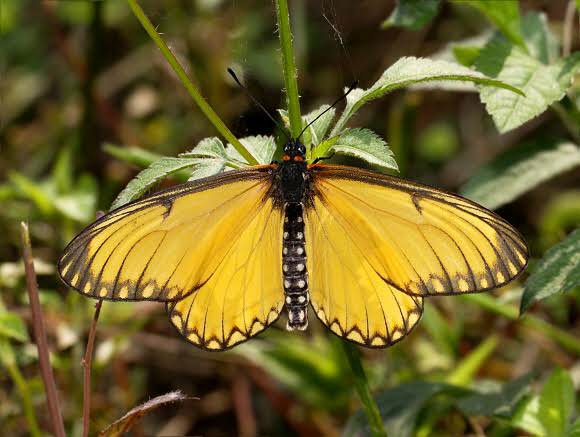
Yellow Coster (Acraea issoria) is a small radiant butterfly with ochre yellowish coloured wings belonging to Nymphalidae family. It has elongated forewings which are slightly translucent and curvy hind-wings. A. issoria is found in India, Myanmar, Thailand, Vietnam, China, Taiwan, Sumatra and Java. Usually this species of butterfly  inhabits mountain valleys at elevation of about 500 to 1000 m but they are also found in Landour, Mussoorie which lies at an elevation of around 2500 msl. During my field visit I found large scale swarming of Yellow coster butterfly in Landour, Mussoorie. The microclimatic condition of Landour has changed drastically within past few years with elevated temperature and rainfall pattern. The Yellow coster butterfly is found mainly along foothills. But high pollution levels and ecological disturbance of their habitat in Dehradun valley might have compelled these creatures to migrate to lesser Himalayas.

Yellow Coster (Acraea issoria)*

Yellow Coster butterflies have a tendency to keep their wings upright while feeding on nectar from diverse flowering species. Otherwise, they like basking under the sun near bushes, thickets and woodlots. The butterfly prefers roosting in areas where its larval host plants belong to Boehmeria sp., Debregasia sp., Elatostema sp. Lantana camara, Eupatorium odoratum, Pouzolzias sp. are good food sources for many butterfly species.  In Landour, Mussoorie, this butterfly species can be seen mostly along the south west aspect due to better sunlight and temperature conditions.

Butterfly life cycle has four stages i.e. egg, larva, pupa and adult. They have to undergo complete metamorphosis to attain full vigour.

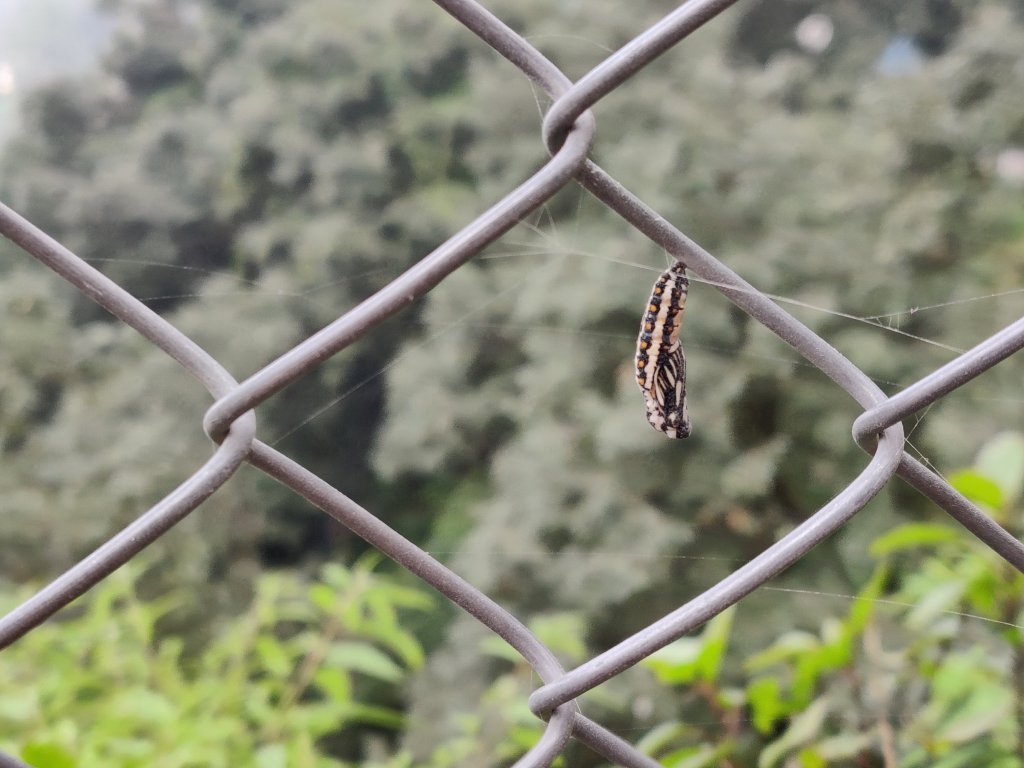
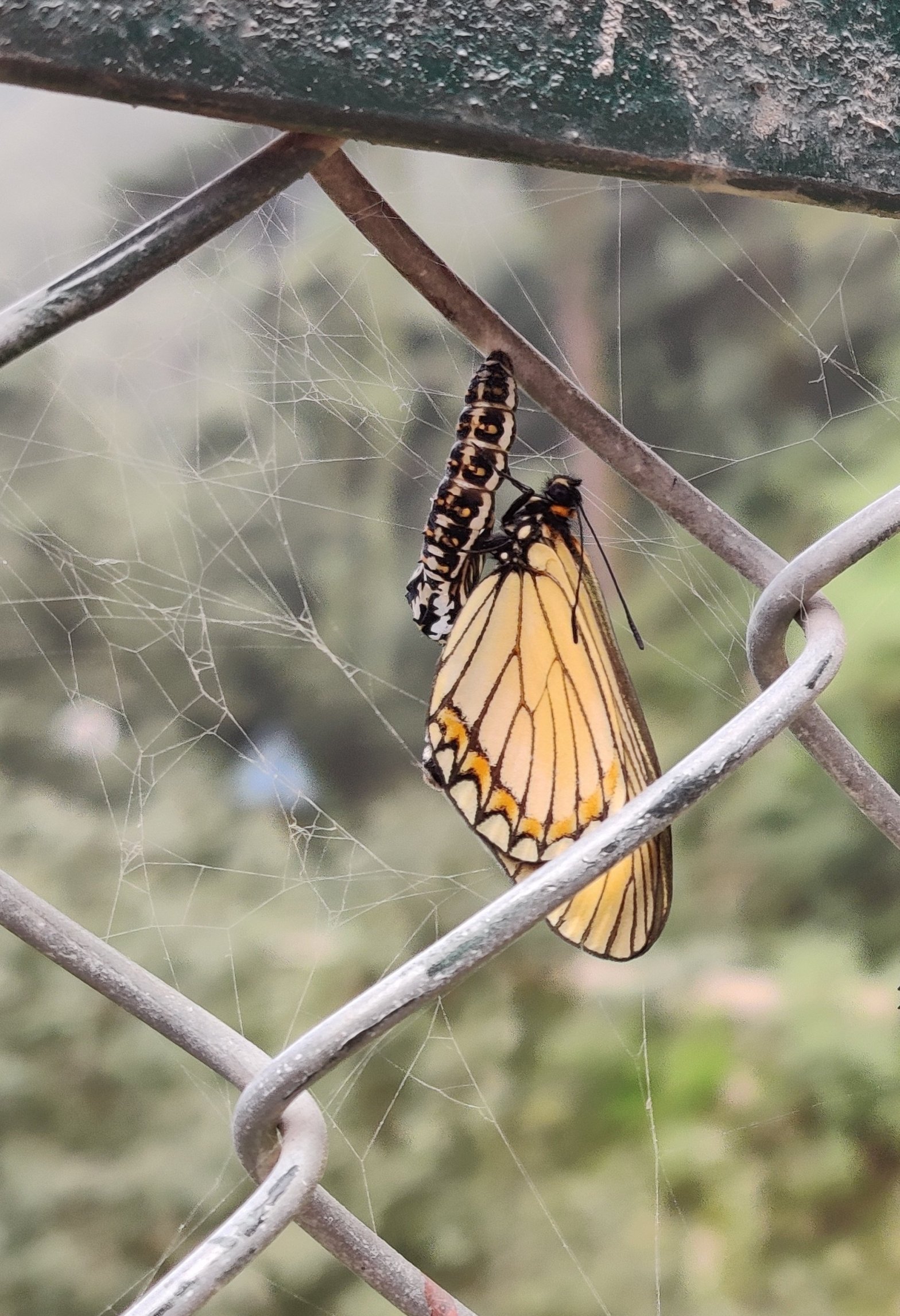
Pupa or chrysalis of yellow coster butterfly (Acraea issoria) resting on wired fence
©sumanmitraphotography

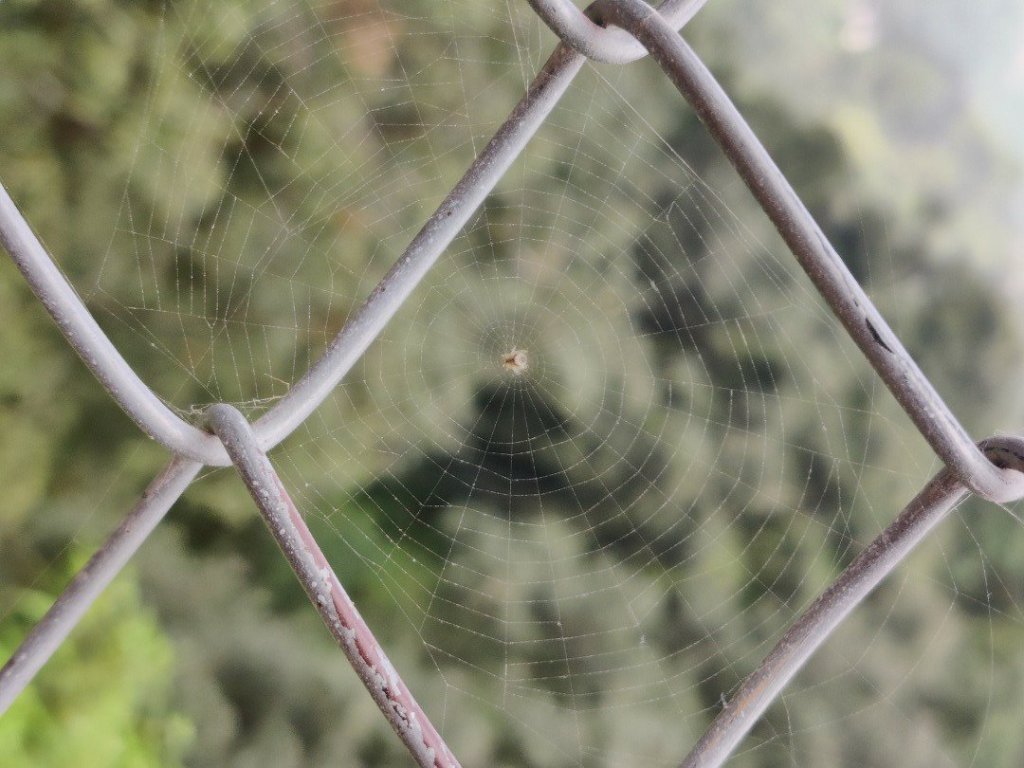
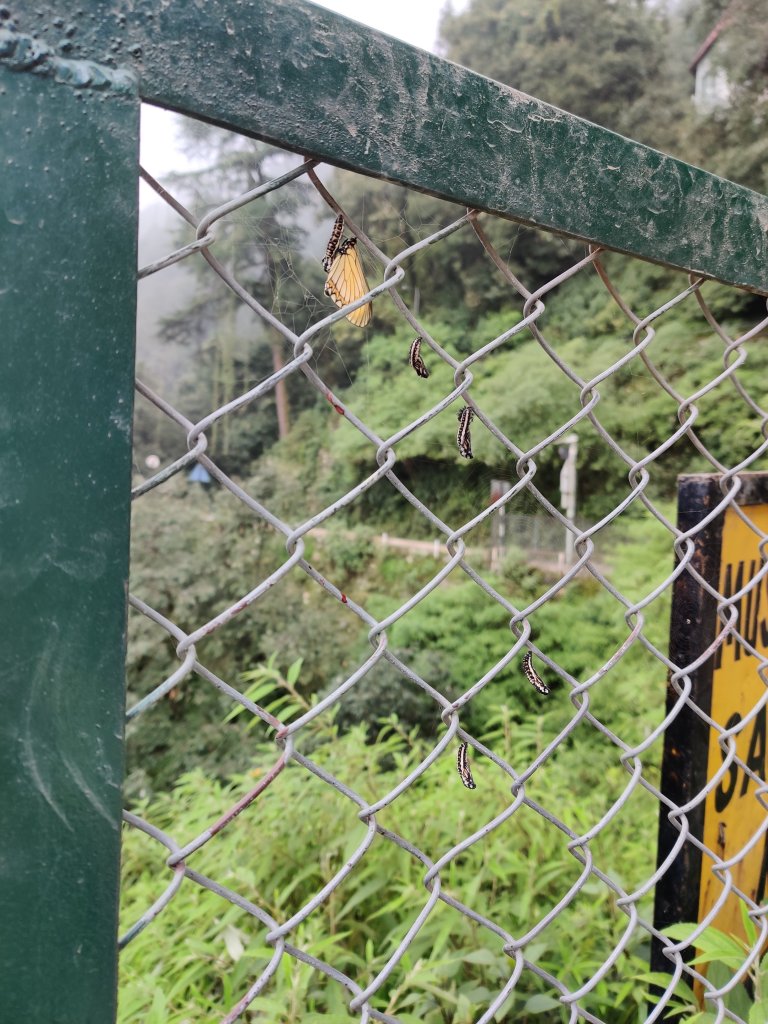
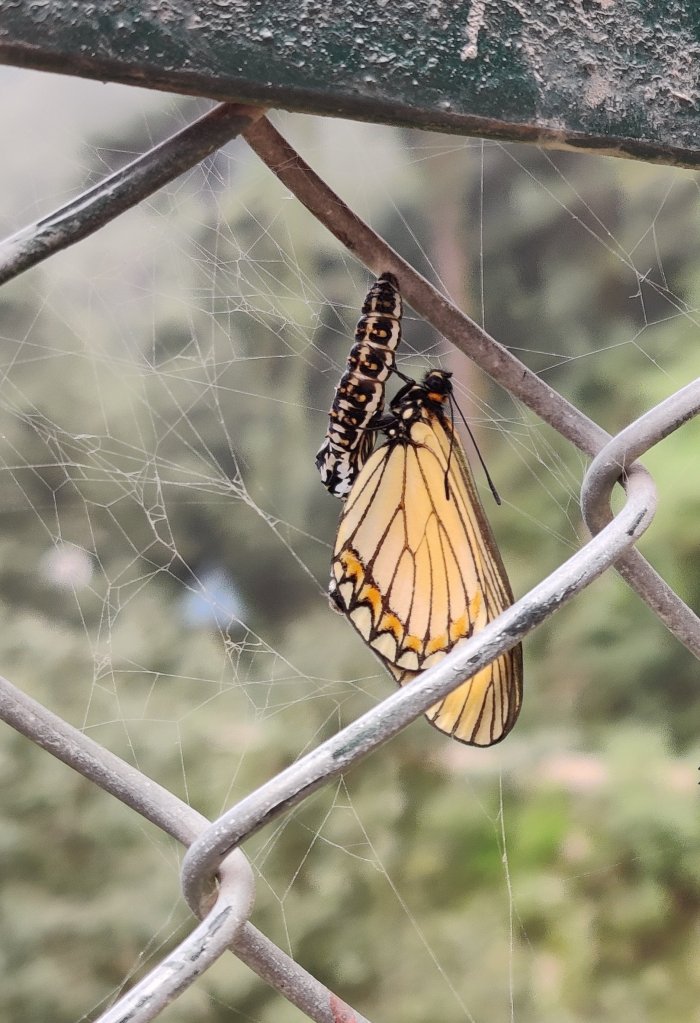
Yellow coster’s life is surrounded with many dangers during their entire life cycle due to predation. One of the common predator of Yellow coster is spider. They often use entrapment by weaving web to trap butterflies who get struck in their sticky net and slowly succumb to death. During field observation I found the chrysalis as well as adult butterfly entangled in spider web in wired fencing. Despite having green cover, the larva of Yellow coster chose wired fencing to metamorphose. Eventually, spiders must have discovered them and wove spider nets around them and ultimately causing death of butterflies. I tried to capture the spider through lens but unable to identify the species. There are many reports on spider predation on butterfly.

Yellow coster entangled in spider web
©sumanmitraphotography
Chrysalis of Yellow coster butterfly
©sumanmitraphotography
Chrysalis of Yellow coster entangled in spider web
©sumanmitraphotography
Spider web to trap butterflies
©sumanmitraphotography
Yellow coster on wired fence
©sumanmitraphotography

Butterflies act as ecological indicators of a healthy environment. Besides they help in pollination of native ground flora thereby facilitating ecological balance. The melodramatic hues, colours, patterns and unique design of butterflies has always inspired artistic minds, poets and writers. These miraculous creatures of mother nature add not only to the aesthetic value to the ecosystem but also has morally uplifted many human souls.

Thank you!!

@chandrimadebi

Picture courtesy

*Internet

https://www.sumanmitra.com/
copyright @sumanmitraphotography

©images and content are subjected to copyright
Yellow coster butterfly predation

Yellow Coster (Acraea issoria) is a small radiant butterfly with ochre yellowish coloured wings belonging to Nymphalidae family. It has elongated forewings which are slightly translucent and curvy hind-wings. A. issoria is found in India, Myanmar, Thailand, Vietnam, China, Taiwan, Sumatra and Java. Usually this species of butterfly  inhabits mountain valleys at elevation of about 500 to 1000 m but they are also found in Landour, Mussoorie which lies at an elevation of around 2500 msl.

Yellow Coster (Acraea issoria)*

Yellow Coster butterflies have a tendency to keep their wings upright while feeding on nectar from diverse flowering species. Otherwise, they like basking under the sun near bushes, thickets and woodlots. The butterfly prefers roosting in areas where its larval host plants belong to Boehmeria sp., Debregasia sp., Elatostema sp. Lantana camara, Eupatorium odoratum, Pouzolzias sp. are good food sources for many butterfly species.  In Landour, Mussoorie, this butterfly species can be seen mostly along the south west aspect due to better sunlight and temperature conditions.

Butterfly life cycle has four stages i.e. egg, larva, pupa and adult. They have to undergo complete metamorphosis to attain full vigour.

Pupa or chrysalis of yellow coster butterfly ( Acraea issoria ) resting on wired fence

Yellow coster’s life is surrounded with many dangers during their entire life cycle due to predation. One of the common predator of Yellow coster is spider. They often use entrapment by weaving web to trap butterflies who get struck in their sticky net and slowly succumb to death. During field observation I found the chrysalis as well as adult butterfly entangled in spider web in wired fencing. Despite having green cover, the larva of Yellow coster chose wired fencing to metamorphose. Eventually, spiders must have discovered them and wove spider nets around them and ultimately causing death of butterflies.I tried to capture the spider through lens but unable to identify the species. There are many reports on spider predation on butterfly.

Yellow coster and chrysalis entangled in spider web
Chrysalis of Yellow coster in spider web
Spider web for trapping butterfly
Yellow coster on wired fence

Butterflies act as ecological indicators of a healthy environment. Besides they help in pollination of native ground flora thereby facilitating ecological balance. The melodramatic hues, colours, patterns and unique design of butterflies has always inspired artistic minds, poets and writers. These miraculous creatures of mother nature add not only to the aesthetic value to the ecosystem but also has morally uplifted many human souls.

Thank you !!

*picture courtesy internet

Geology around Woodstock school, Mussoorie

Woodstock school is one of the oldest residential schools in Asia and was established in the year 1854. The school is nestled in lesser Himalayas in a small quiet town of Landour near Mussoorie, Uttarakhand. The geographical location is at  30.4543° N, 78.1005° E.

Woodstock School, Landour, Mussoorie

The campus of the school lies along the protective forest area of Mussoorie at an altitude of around 7000 feet. Woodstock school encompasses an area of around 300 acres approximately.

View of Woodstock School from Mussoorie

The geology, lithology and stratigraphy in and around Woodstock school is remarkable. The rock types mainly comprises of Quartzite , dolomitic limestone, cemented terrigenous sedimentary rocks which mainly comprise of sandstone with beds of clay , minor clay shale beds, slate and phyllites, schist, shale with interbedded clayey and non-clayey rocks weathered shale and schists. The rockbeds dip in the south east direction and strike is in the northeast and southwest direction.

Clayey to sandy soil with mixed rock pieces and debris

Due to action of various weathering agents such as heavy rainfall, snowfall, wide range of temperature difference between day and night, the rock minerals are highly disintegrated. The limestones are easily soluble in water and cause weathering of the rock along joints and crevasses leaving behind bare mountain faces. There are erosional valleys which are youthful in their development. Geomorphologicaly the area is in the initial state of its development due to high denudation. During heavy rainfall high rate of removal of top soil takes place through gullies and channels in and around the campus.

The soil type mainly comprises of argillaceous shale, clayey soil with naturally formed surface (alluvial) , debris comprising mostly rock pieces mixed with clayey/sandy soil, older well compacted and younger loose material.There are few springs around Landour which are mostly confined to shales. Along the hillside small intermittent streamlets are there where nallas have cut gullies below ground level. In some places water oozes out of the carbonaceous bed along Tehri road.

Geology, soil and vegetation are not only interdependent but are also functionally
inseparable. The flora is an important factor of soil formation and the floral composition in an area also gives an insight into soil and geomorphic and geological conditions. Changes in either vegetation or soil cover are interalia affect each other.

Diverse flora around Woodstock school, Mussoorie
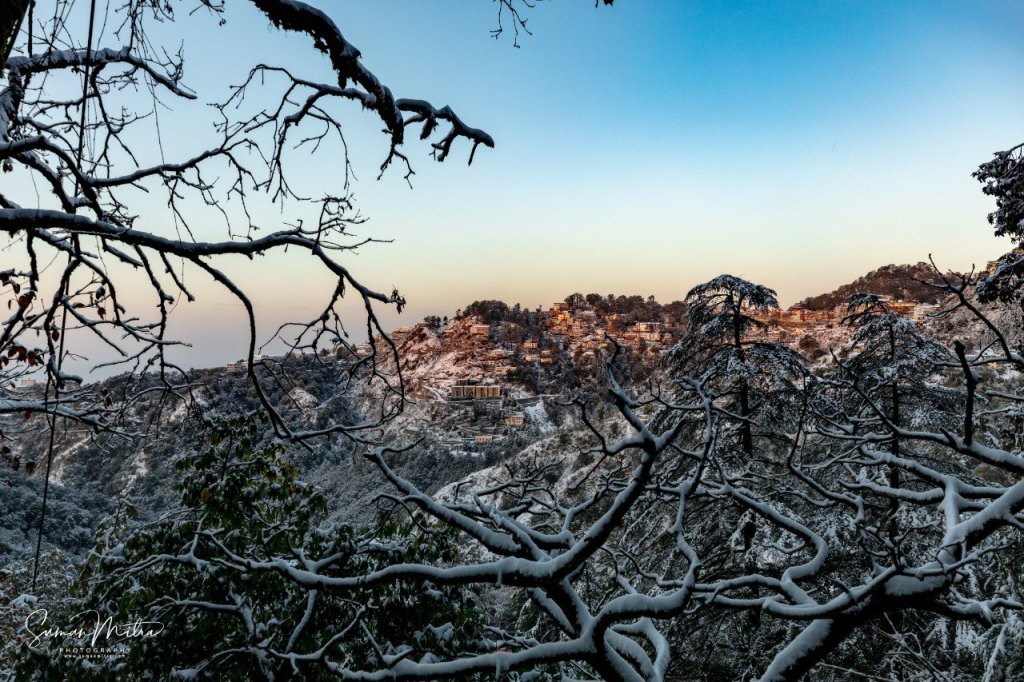
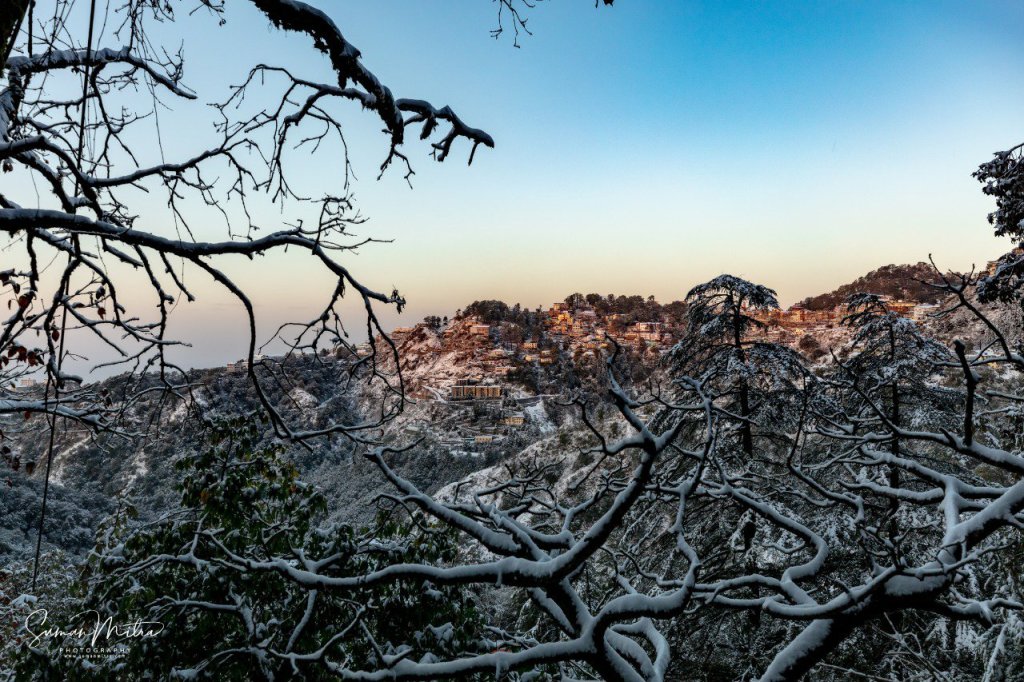
View of Mussoorie after snowfall from Woodstock School, Landour
After snowfall in Landour

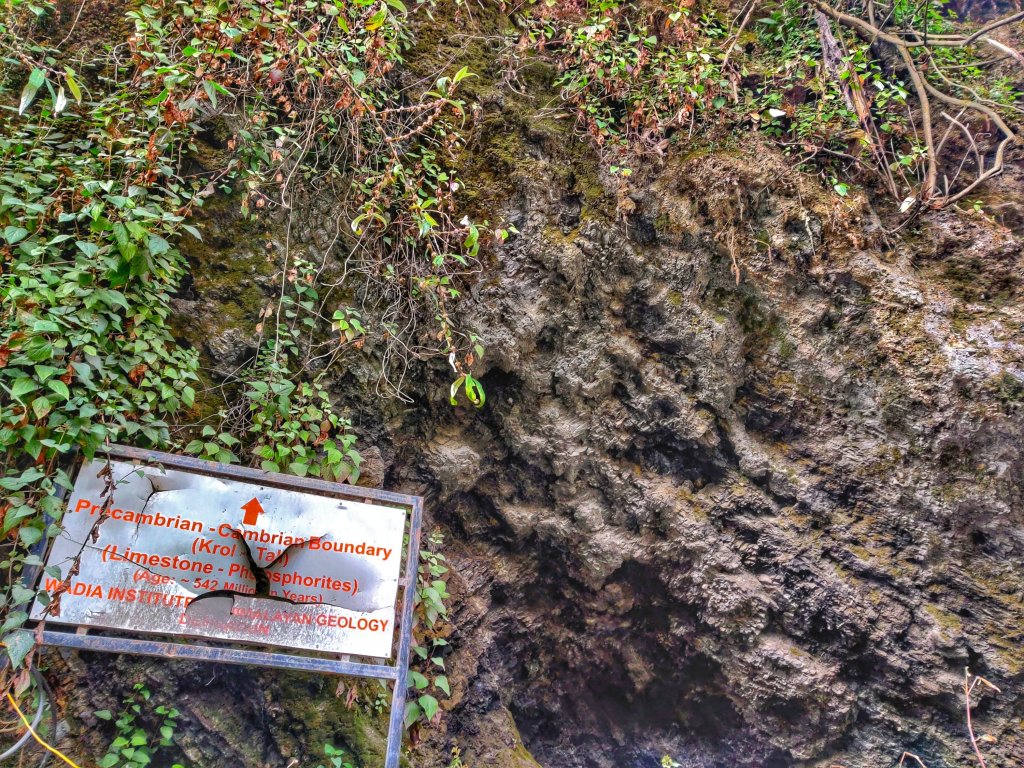
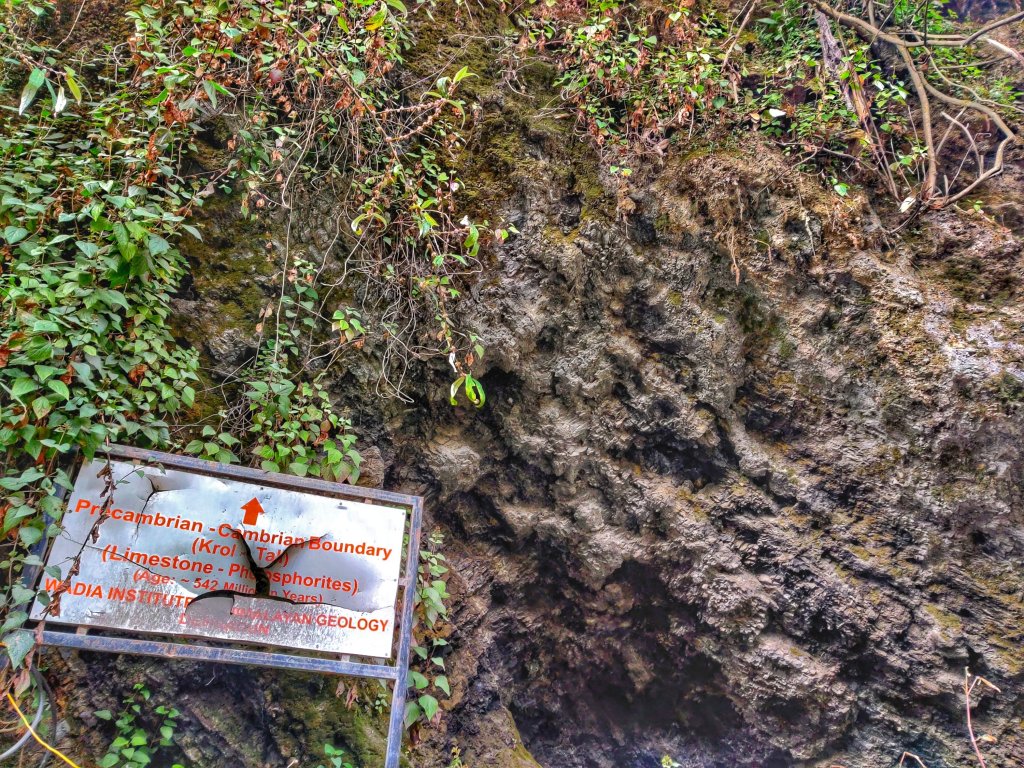
One can easily observe high metamorphic and sedimentary complexes with rocktypes beyond 500 million years on geological time scale around Woodstock school. Mussoorie and surrounding area are very important with respect to geological perspective. If one is interested in the stratigraphical studies, this area consists of remarkable features to study. Major formations in Mussoorie group consist of the Tal formation overlying the Krol formation and Blaini formation.  The Tal formation is well exposed along the Krol Belt, and is overlying the Precambrian Krol Group.The Blaini formation is overlained by the  Krol formation. One can easily notice this  geological feature when one reaches Woodstock school via Mussoorie bypass NH 707A. The feature has Precambrian and Cambrian boundary made up limestone and phosphorites. The rocktypes are around 542 million years old.

Precambrian and Cambrian boundary (Krol- Tal formation)
Limestone and phosphorites along Krol – Tal formation boundary

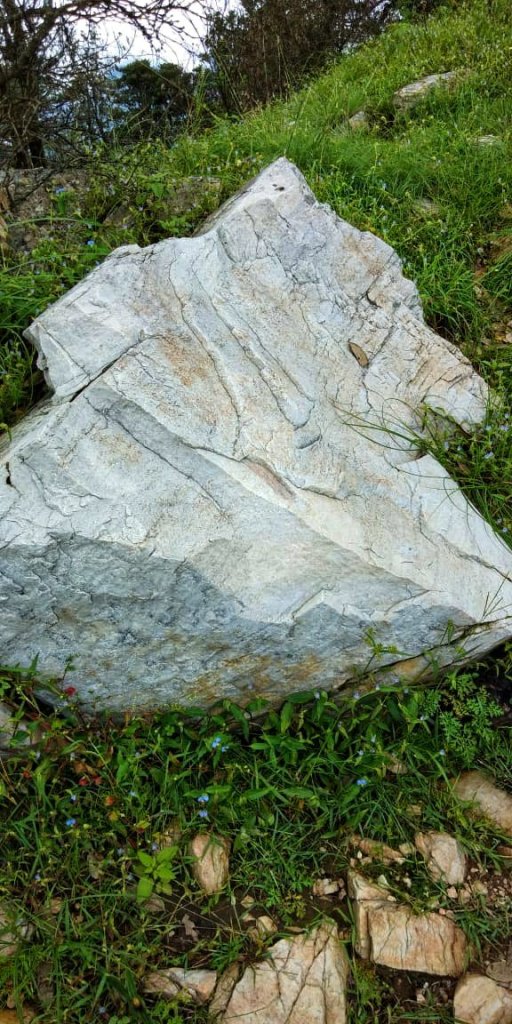
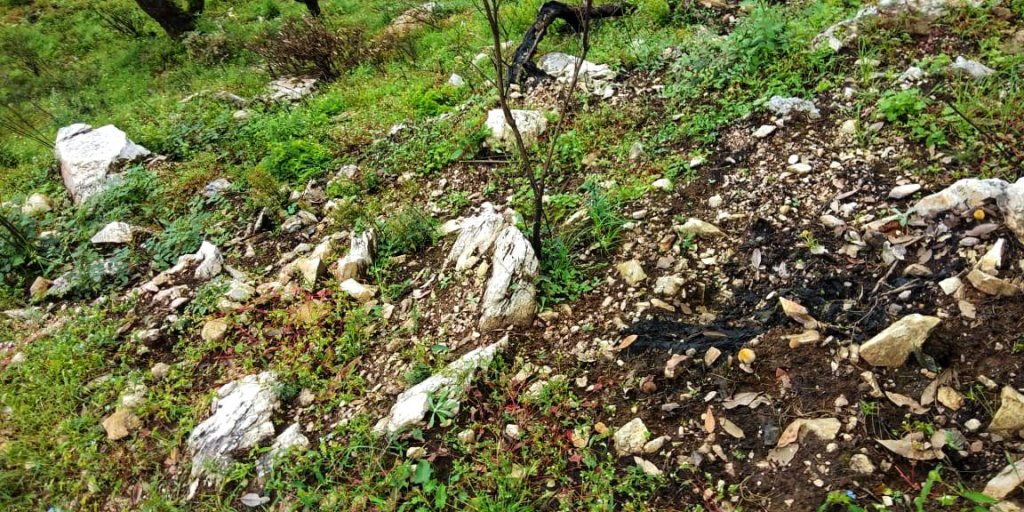
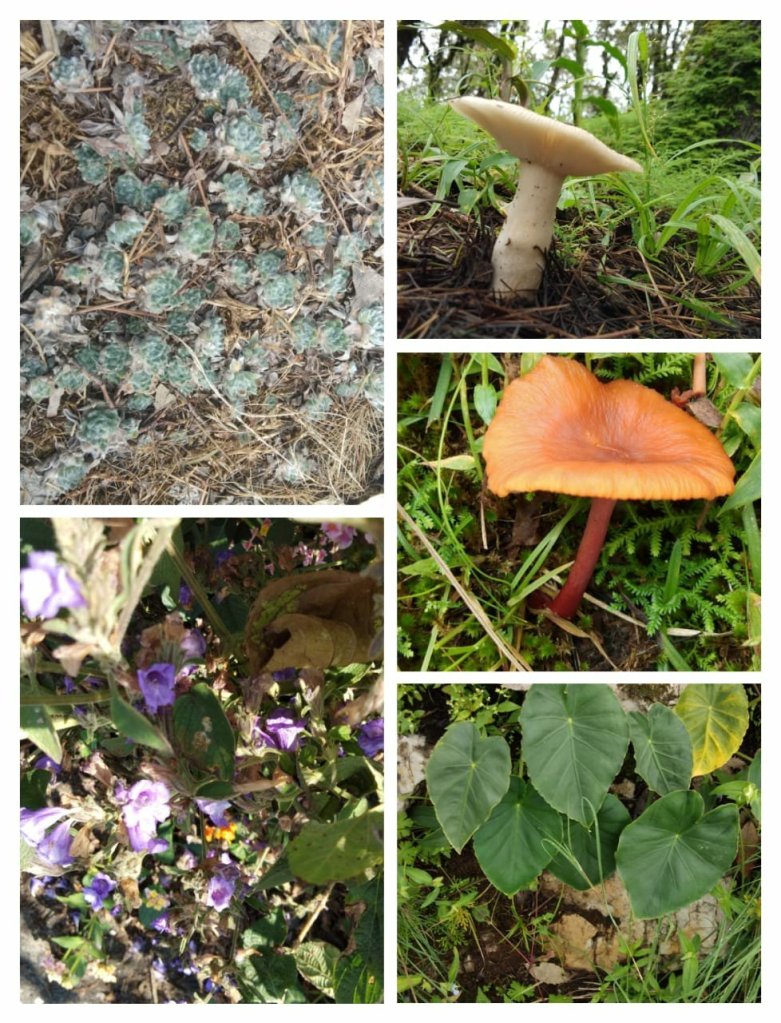
The Jabarkhet Nature Reserve is a private owned forest which lies around 3 kms ahead of Woodstock school. Earlier this area was ecologically degraded and overgrazed. But with the genuine efforts of the local people and various scholars this nature reserve is now replenishing and blooming with floral and faunal biodiversity. The rocktypes mainly comprise of Quartzites, limestones, dolomitic limestone, sedimentary rocks which mainly comprise non-clayey rocks weathered shale,and schists and debris. One can observe joint planes, rock fractures, cleavages along the massive boulders in Flaghill. The soil type is clayey soil with naturally formed surface (alluvial) , debris comprising mostly rock pieces mixed with clayey/sandy and weathered soil, older well compacted and younger loose material. The soil is slightly acidic. Jabarkhet nature reserve also serves as local learning resource and outdoor activities.  

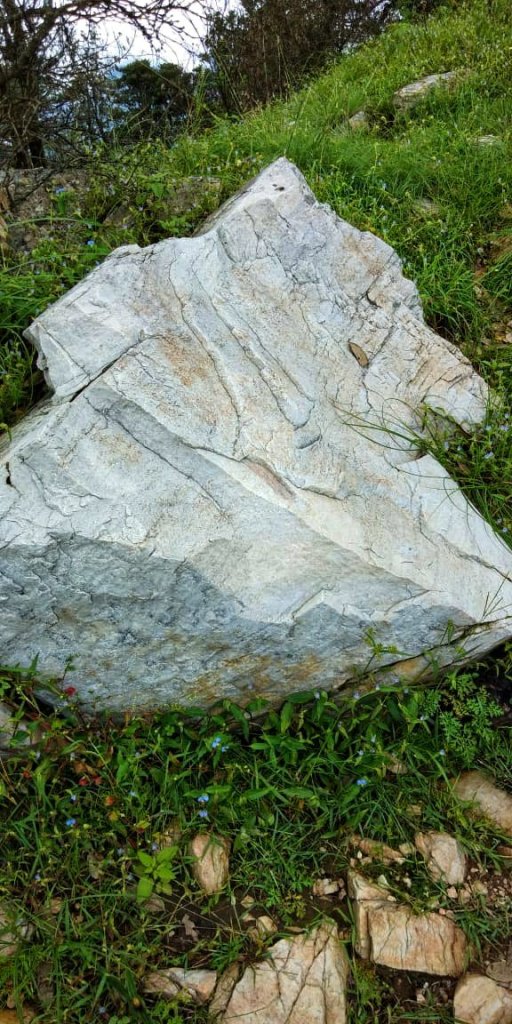
Limestone and dolomitic limestone rocks and boulders in Jabarkhet Nature Reserve
Debris and rock pieces mixed with clayey and sandy soil
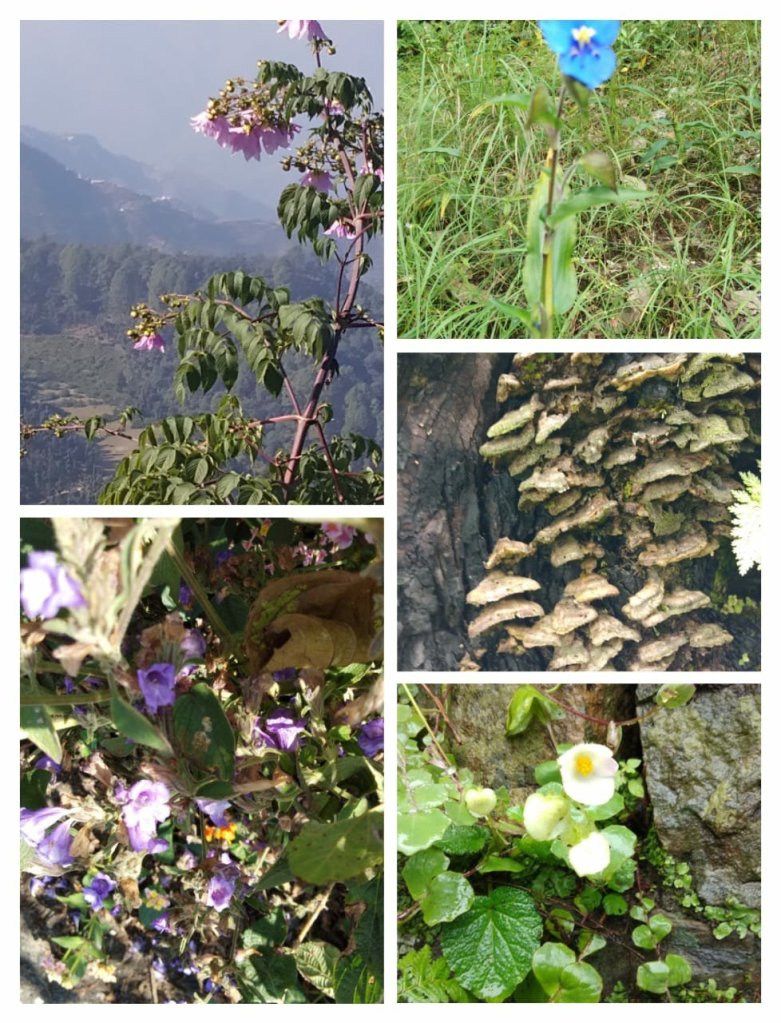
Diverse flora and mushrooms in Jabarkhet Nature Reserve

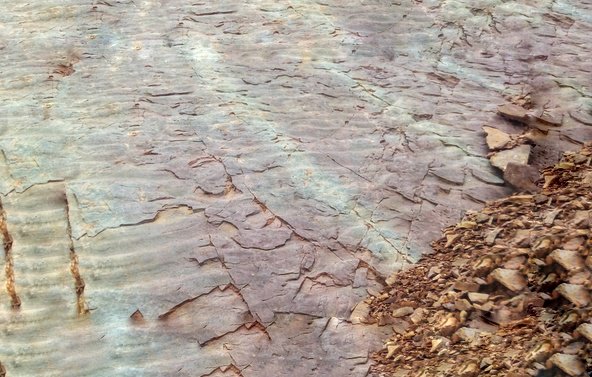
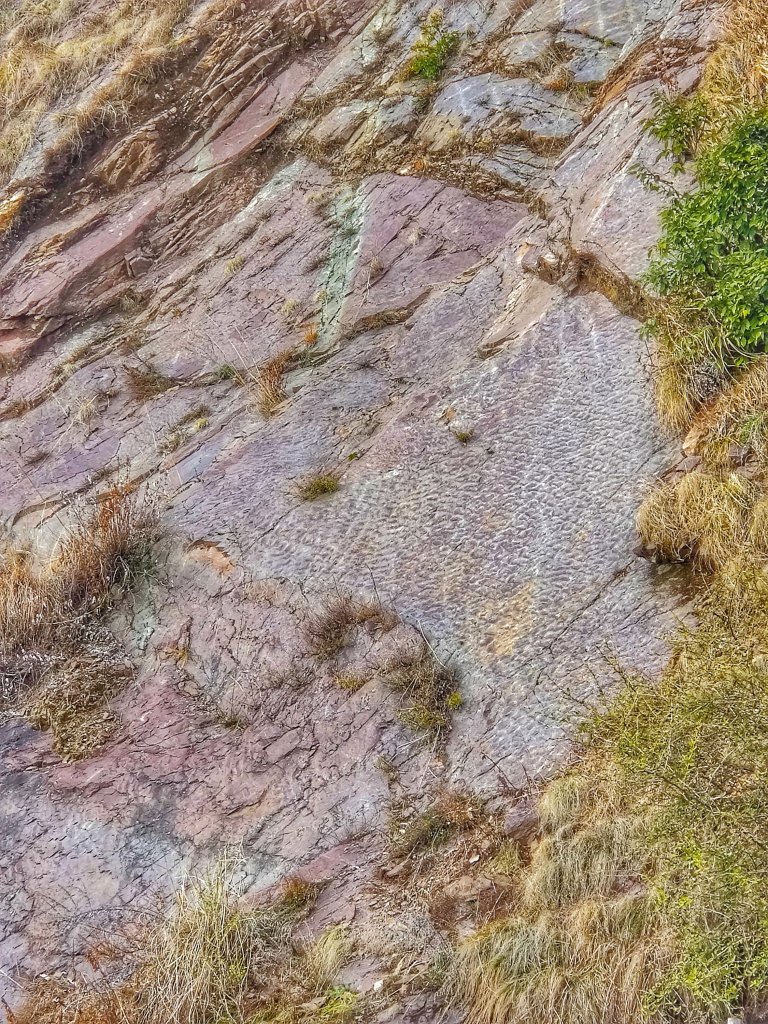
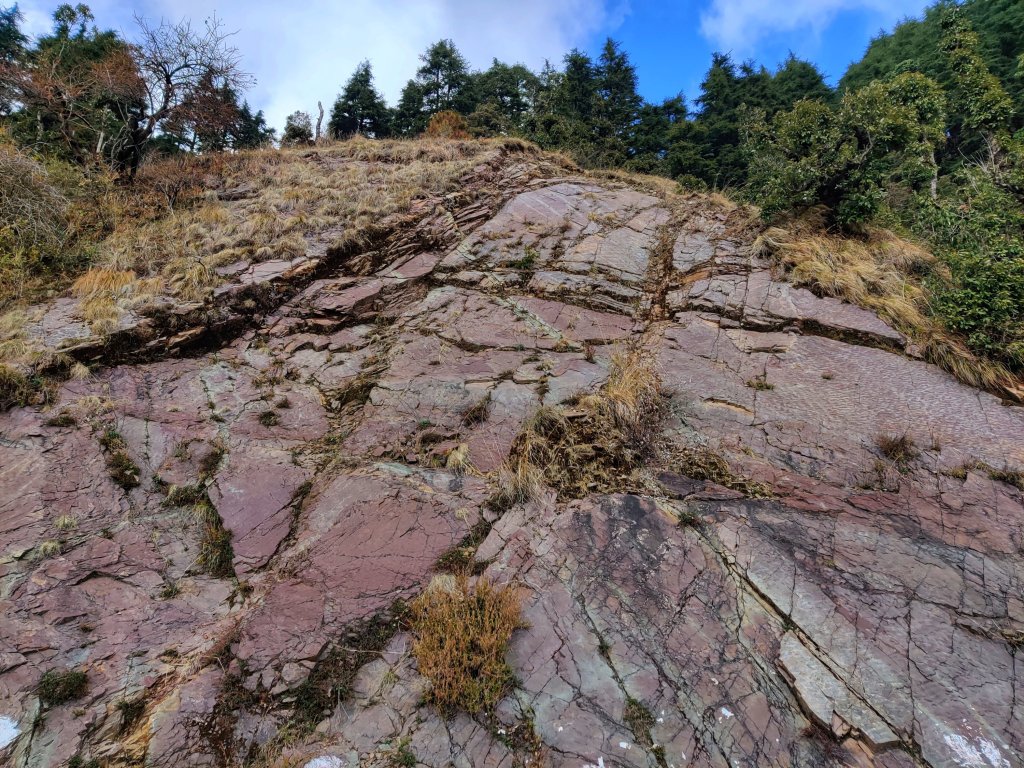
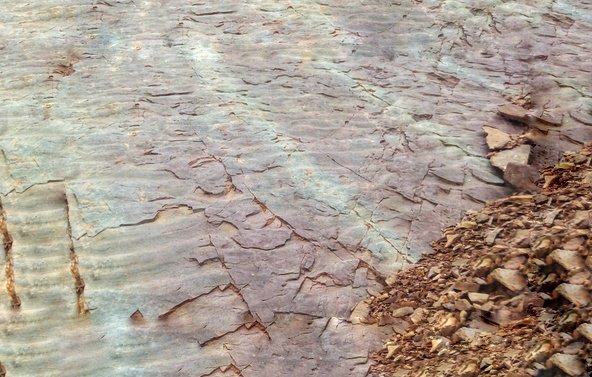
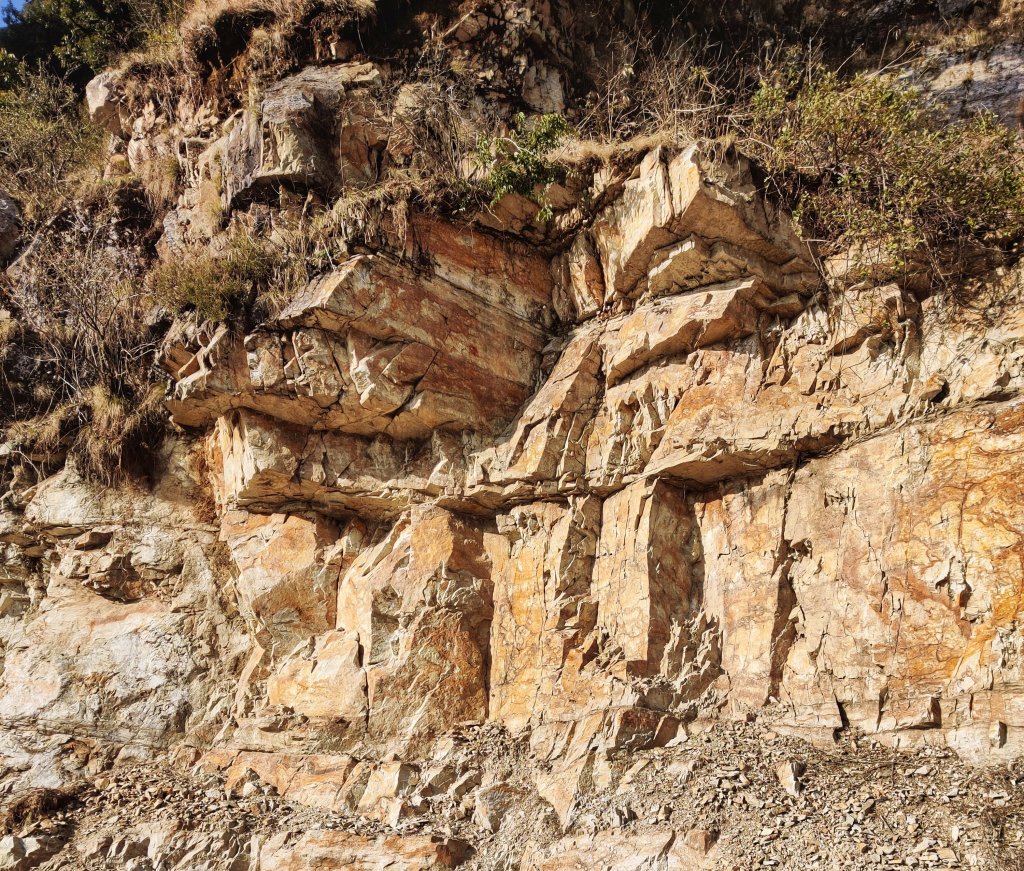
About 7 kilometres ahead of Woodstock school near Kaplani, there lies inclined bedding planes which are dipped in southwest angle. The bedding planes are made out of red sandstone. The beds display ferrous leaching. Joints and fracture also can be clearly seen. The sedimentary structure shows unique Ripple marks. The ripple marks are mostly present in the Sandstones, which are mostly ferruginous in content. The ripple marks at this site show different current directions.

Mega ripple marks on Sandstone
Inclined bedding planes of Red Sandstone showing ripple marks near Kaplani

In Dhobighat area, one can easily notice exposures of dolomitic limestone alongwith weathered cherty phosphorites. The beds dip in the northeast direction. Subsurfacial perennial affluent streams can be observed.

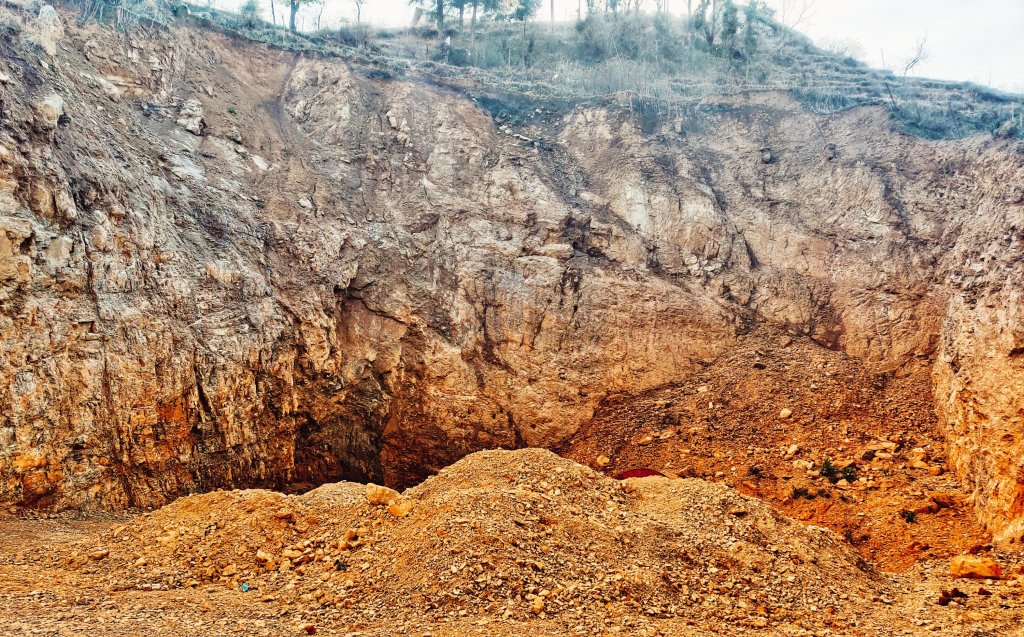
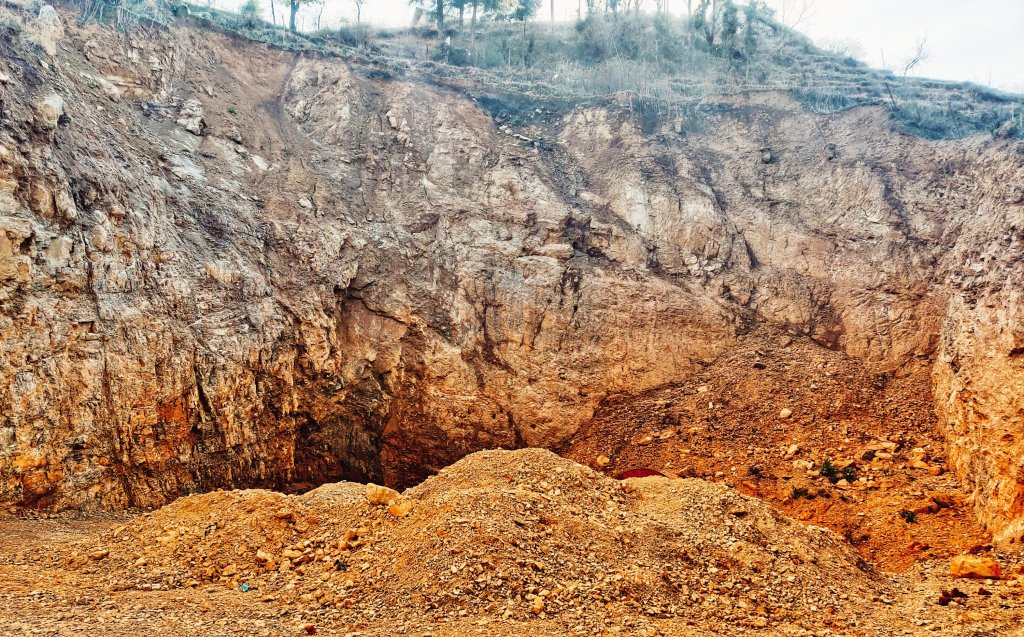
The scarp facets along the road has large detached rocks which have moved as rock-falls. Many roadside accident have also occurred in the past due to sudden rockfalls. In most places the fragmented boulders and rocks are loosely attached and can slide any moment. Due to increased transport near Mussoorie – Tehri road new road constructions are taking place.

Intercalation of bedding planes
Rock excavation

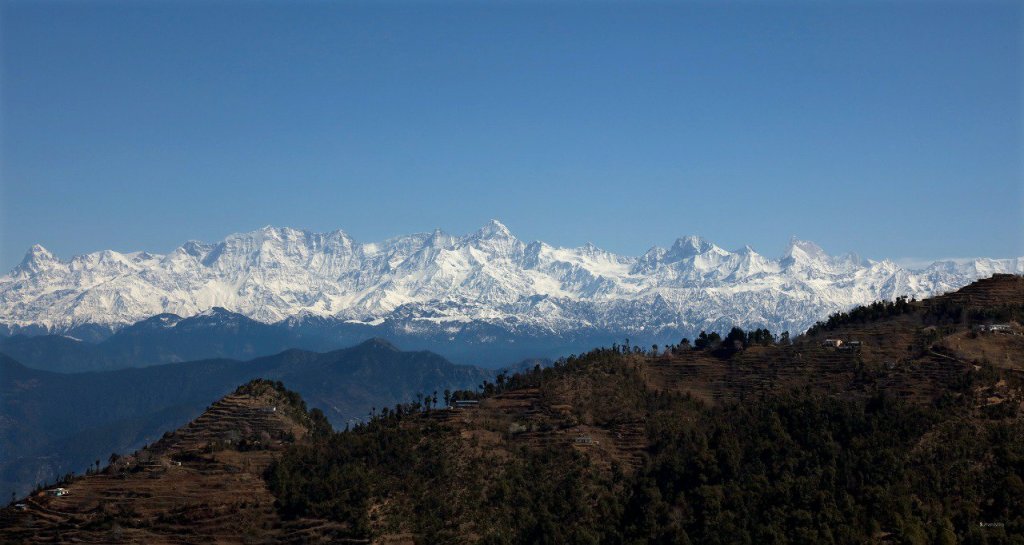
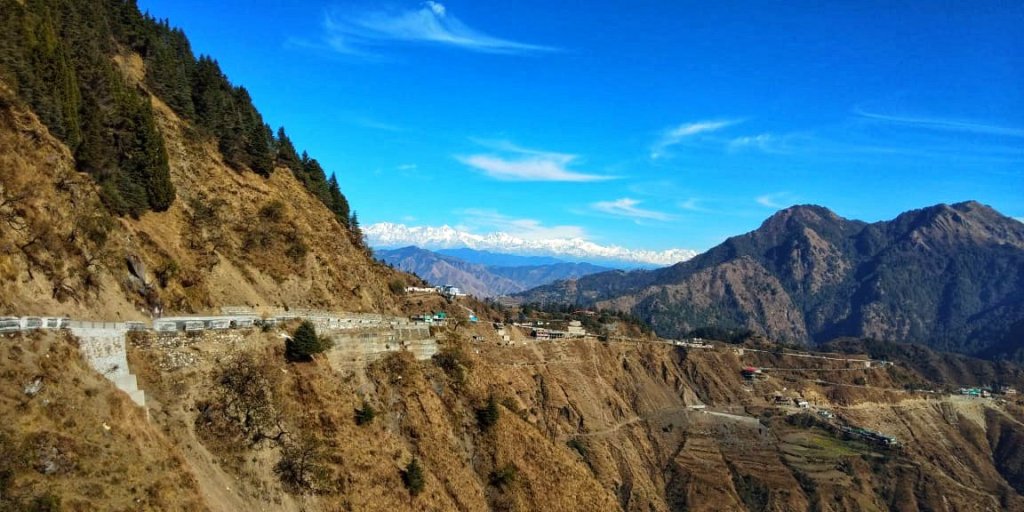
On a bright sunny day one can observe majestic view of the snow covered Himalayas, if one follows the road from Woodstock school towards Dhanaulty,

Mussoorie lies in the seismic zone 4 and has witnessed several earthquakes. These days one can observe numerous construction along roadsides as well as on slopes. According to recent reports an earthquake will collapse urban areas in Mussoorie and surrounding areas. So care should be taken while construction and damage assessment of the buildings should be done.

There are ample research work available on the geological studies around Mussoorie, but during my study I didn’t came across any work which studies the geology in and around Woodstock school. Despite covering vast geographical area of around 300 acres, which mainly comprise of Oak, Deodar and Pine forest not enough attention is given towards the geology as well as changing geomorphology of this particular area. There are ample rock exposures where students can visit to study various geological aspects.The information presented in this blog is far from complete. However, effort is to collect information and continue studies and further update more information  and go on for the quest of knowledge of the geological setup of this particular area.

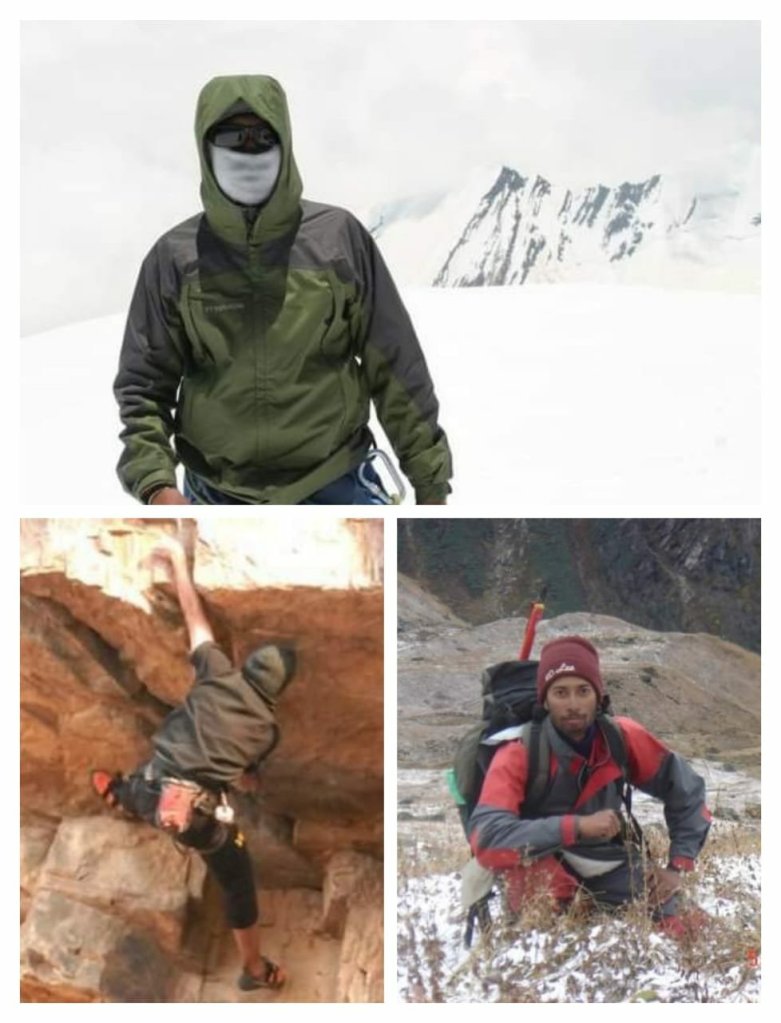
Mountaineers exploring geological terrains

Geology is an essential knowledge: climbing success – or even your life – can depend on your understanding the form and substance that form the mountains…verse from the book.. Mountaineering… Freedom of the hills.

Panoramic view of Himalayas

Thank you !!!

Pictures @sumanmitraphotography.com

Fireflies and climate change in Landour, Mussoorie

We are all familiar with Fireflies or commonly known as lightning bugs. To me, these creatures resemble ‘Nature’s lantern’ which can light up even the darkest corners. But these mystical and charismatic insects are actually beetles and nocturnal members of the family Lampyridae. Most fireflies are winged and are distinct from other luminescent insects of the same family, commonly known as glowworms. Many species of this twinkling beetles are threatened and are listed in IUCN Red List.

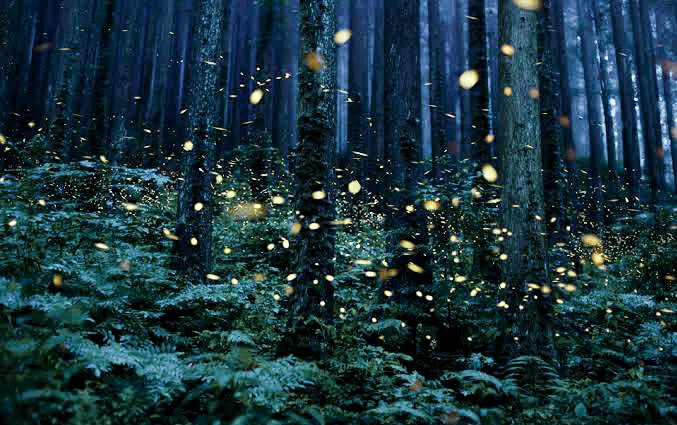
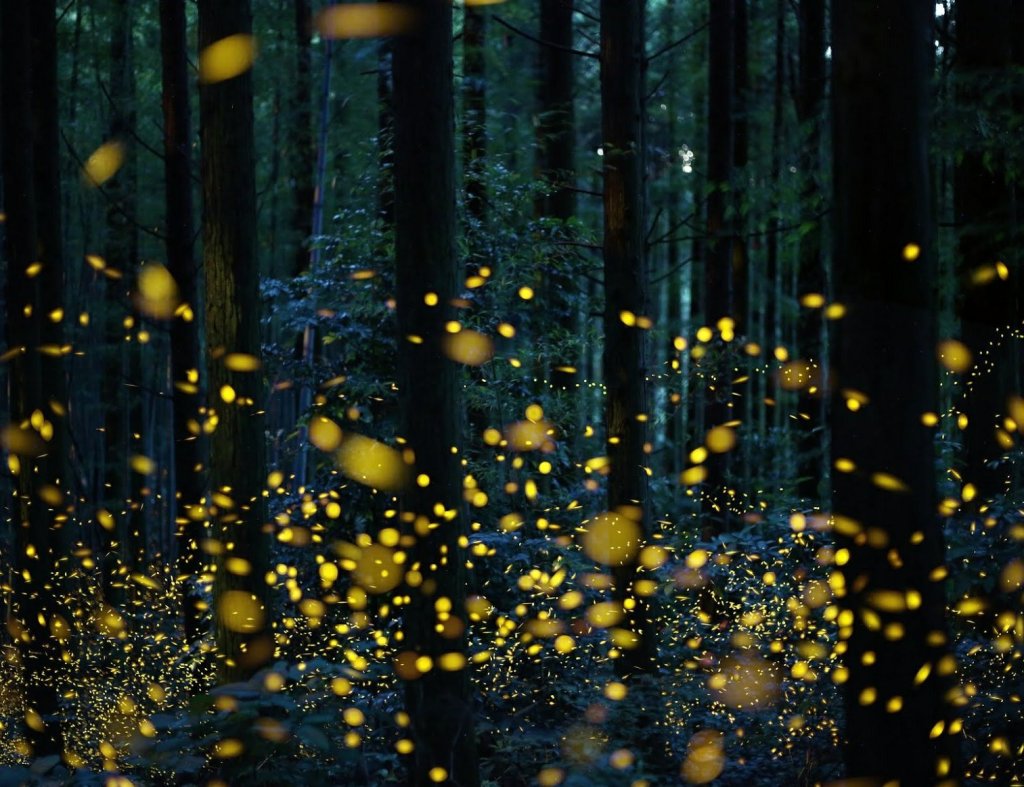
Fireflies in forest

Fireflies live in various habitats but they have an affinity towards humid, warm environments. Many species thrive in forests, fields or the margins between them. There are many species of fireflies throughout the world, and the most diversity in species is found in tropical Asia as well as Central and South America. are found all over the world, from North and South America to Europe and Asia.

In India, Landour is located in the Lower Western Himalaya, in the Mussoorie Range. Landour is about 984 ft (300 m) above Mussoorie, which itself is mostly at an altitude of 6,800 to 7,798 ft. As summers have become comparatively warmer in Landour, Mussoorie, fireflies are being observed more than usual across the region. During my interaction with the local people in Landour, Mussoorie, who are staying there for more than 25 years, there were no fireflies in the area. But there is a sudden increase in the count of fireflies, which has been noticed recently. There are various reports which show that with the change in the global climatic conditions the ecological habitat and distribution of the fireflies is also changing.

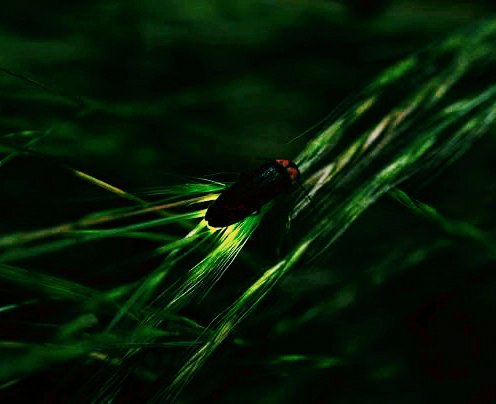
A firefly on a leaf

Fireflies signal the effect of a changing climate. One study was undertaken by scientists in Michigan to understand how climate change can affect fireflies. The study revealed that the warmer springs predicted by climate change would mean an earlier firefly peak, but only if rainfall remains the same. Entomology Professor Michael Hoffman says that one possible reason for the seeming increase in numbers of fireflies in Michigan may be caused by wet springs, a trend that will occur with climate change in the Northeastern U.S.

So whether the climate change or some other factor which has resulted in the increased count of fireflies in Landour is an interesting area of study for entomologists.

Fireflies during dusk

Along with the onset of monsoons and elevated temperature there is an increase in the count of mosquitoes also in the area. Over the years the area has witnessed many constructional transformations in lieu of development and urbanization. The forest cover has also deteriorated which has otherwise resulted in a high rate of soil erosion further paving way for puddles and ditches which are breeding sites for mosquitoes. Large scale dumping of garbage along the highway near bypass road is also one of the causes which have further disturbed the ecology of this area.

These ecological changes might have triggered the ecological disturbance in the area. The recent reports show that fireflies are dying because of humans killing Earth’s natural magic. There is evidence that fireflies have vanished from many places where they formerly were abundant due to urbanisation, industrialisation, agricultural intensification and light pollution. There are many efforts being carried out all over the world to protect and conserve the fireflies as well as their natural habitat.

There are a lot number of people who hate insects, but fireflies are adored mostly. ‘These tiny little glowing creatures are nature’s little lanterns amidst intense darkness.’

Fireflies glowing

The following incident gave me the insight to write a few lines on one of my favourite insects ie Firefly…
It was a humid summer in Landour, Mussoorie. I was lying in my cosy bed along with my baby with moonlight streaming inside through the window. Suddenly I observed one small light was twinkling and hovering on my window. Even though my window covered with insect net still that twinkling light somehow managed to get inside my bedroom and was roaming from this corner to that. I was wondering what that could be, is it a firefly or something else. Because within my two years stay in Landour, I didn’t come across fireflies. I got up and found that it was a firefly. That little twinkling light brought immense happiness in the darkroom as well as in some corner of my mind.

Thank you !!

A Firefly

@pictute courtesy internet

Fireflies and Climate change in Landour, Mussoorie

We are all familiar with Fireflies or commonly known as lightning bugs. To me these creatures resemble ‘Nature’s lantern’ which can light up even the darkest corners. But these mystical and charismatic insects are actually beetles and nocturnal members of the family Lampyridae. Most fireflies are winged and are distinct from other luminescent insects of the same family, commonly known as glowworms. Many species of this twinkling beetles are threatened and are listed in IUCN Red list.

Fireflies in forest

Fireflies live in various habitats but they have affinity towards humid, warm environments. Many species thrive in forests, fields or the margins between them. There are many species of fireflies throughout the world, and the most diversity in species is found in tropical Asia as well as Central and South America. are found all over the world, from North and South America to Europe and Asia.

Firefly on leaf

Landour is located in the Lower Western Himalaya, in the Mussoorie Range. Landour is about 984 ft (300 m) above Mussoorie, which itself is mostly at an altitude of 6,800 to 7,798 ft. As summers have become comparatively more warmer in Landour, Mussoorie, fireflies are being observed more than usual across the region. During my interaction with the local people in Landour, Mussoorie, who are staying here for more than 25 years, there were no fireflies in the area. But there is sudden increase in the count of fireflies, which  has been noticed recently. There are various reports which show that with the change in the global climatic conditions the ecological habitat and distribution of the fireflies is also changing.

Fireflies signal the effect of a changing climate. One study was undertaken by the scientists in Michigan to understand how climate change can affect fireflies. The study revealed that the warmer springs predicted by climate change would mean an earlier firefly peak, but only if rainfall remains the same. Entomology Professor Michael Hoffman says that one possible reason for the seeming increase in numbers of fireflies in Michigan may be caused by wet springs, a trend that will occur with climate change in the Northeastern U.S

Fireflies during dusk

So whether the climate change or some other factor which has resulted in the increased count of fireflies in Landour is an interesting area of study for entomologists.

Alongwith the onset of monsoons and elevated temperature there is increase in the count of mosquitoes also in the area. Over the years the area has witnessed many constructional transformations in lieu with development and urbanization. The forest cover has also deteriorated which has otherwise resulted in high rate of soil erosion further paving way for puddles and ditches which are breeding sites for mosquitoes. Large scale dumping of garbage along the highway near bypass road is also one of the cause which has further disturbed the ecology of this area.

These ecological changes might have triggered the ecological disturbance in the area.The recent reports show that fireflies are dying because of humans killing Earth’s natural magic. There is evidence that fireflies have vanished from many places where they formerly were abundant due to urbanisation, industrialisation, agricultural intensification and light pollution. There are many efforts being carried out all over the world to protect and conserve the fireflies as well as their natural habitat.

There are a lot number of people who hate insects, but fireflies are adored mostly. ‘These tiny little glowing creatures are nature’s little lanterns amidst intense darkness.’

Fireflies glowing

The following incedent gave me insight to write few lines on one of my favourite insects ie Firefly…
It was a humid summer in Landour, Mussoorie. I was lying in my cozy bed alongwith my baby with moonlight streaming inside through the window. Suddenly I observed one small light was twinkling and hovering on my window. Even though my window covered with insect net still that twinkling light somehow managed to get inside my bedroom and was roaming from this corner to that. I was wondering what that could be, is it a firefly or something else. Because within my two years stay in Landour, I didnt come across fireflies. I got up and found that it was a firefly. That little twinkling light brought immense happiness in the dark room as well as in some corner of my mind.

A firefly… Nature’s lantern

Thank you!!

@chandrimadebi

Picture courtesy internet

©content subjected to copyright

Geology around Woodstock school, Mussoorie

Woodstock school is one of the oldest residential schools in Asia and was established in the year 1854. The school is nestled in lesser Himalayas in a small quiet town of Landour near Mussoorie, Uttarakhand. The geographical location is at  30.4543° N, 78.1005° E.

Woodstock School, Mussoorie
©sumanmitraphotography

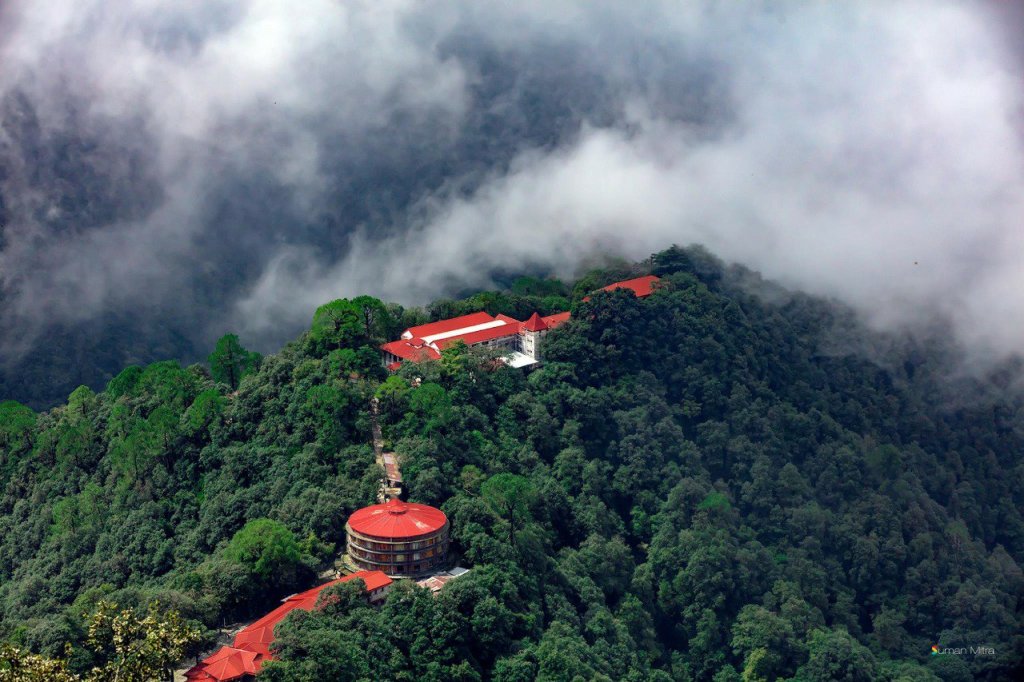
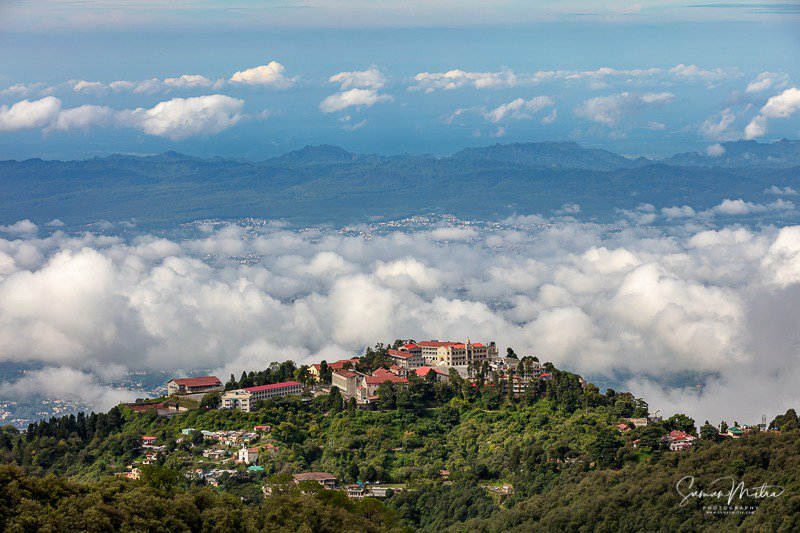
The campus of the school lies along the protective forest area of Mussoorie at an altitude of around 7000 feet. Woodstock school encompasses an area of around 300 acres approximately. The picturesque panorama depicts as of an ‘inselberg’ an island mountain.

View of Woodstock school from Mussoorie ©sumanmitraphotography

The geology, lithology and stratigraphy in and around Woodstock school is remarkable. The rock types mainly comprises of Quartzite , dolomitic limestone, cemented terrigenous sedimentary rocks which mainly comprise of sandstone with beds of clay , minor clay shale beds, slate and phyllites, schist, shale with interbedded clayey and non-clayey rocks weathered shale and schists. The rockbeds dip in the south east direction and strike is in the northeast and southwest direction.

Panoramic view amidst clouds, Mussoorie
©sumanmitraphotography

Due to action of various weathering agents such as heavy rainfall, snowfall, wide range of temperature difference between day and night, the rock minerals are highly disintegrated. The limestones are easily soluble in water and cause weathering of the rock along joints and crevasses leaving behind bare mountain faces. There are erosional valleys which are youthful in their development. Geomorphologicaly the area is in the initial state of its development due to high denudation. During heavy rainfall high rate of removal of top soil takes place through gullies and channels in and around the campus.

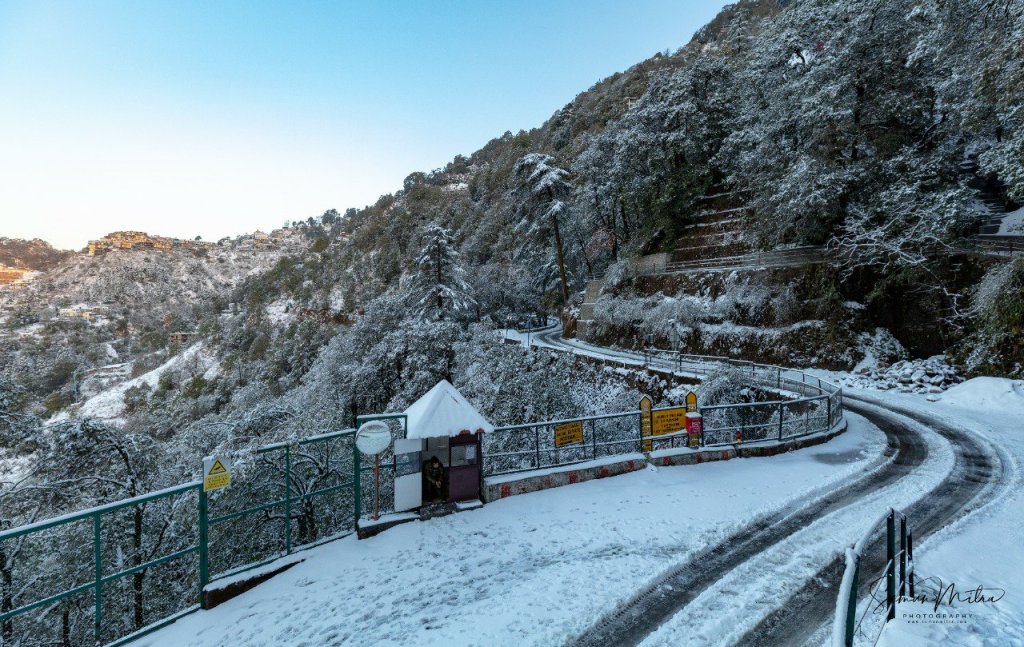
Snowfall near Woodstock school, Mussoorie
©sumanmitraphotography
View of Mussoorie after snowfall from Woodstock School, Landour
©sumanmitraphotography

The soil type mainly comprises of argillaceous shale, clayey soil with naturally formed surface (alluvial) , debris comprising mostly rock pieces mixed with clayey/sandy soil, older well compacted and younger loose material.There are few springs around Landour which are mostly confined to shales. Along the hillside small intermittent streamlets are there where nallas have cut gullies below ground level. In some places water oozes out of the carbonaceous bed along Tehri road.

Clayey to sandy soil with mixed rock pieces and debris

One can easily observe high metamorphic and sedimentary complexes with rocktypes beyond 500 million years on geological time scale around Woodstock school. Mussoorie and surrounding area are very important with respect to geological perspective. If one is interested in the stratigraphical studies, this area consists of remarkable features to study. Major formations in Mussoorie group consist of the Tal formation overlying the Krol formation and Blaini formation.  The Tal formation is well exposed along the Krol Belt, and is overlying the Precambrian Krol Group.The Blaini formation is overlained by the  Krol formation. One can easily notice this  geological feature when one reaches Woodstock school via Mussoorie bypass NH 707A. The feature has Precambrian and Cambrian boundary made up limestone and phosphorites. The rocktypes are around 542 million years old.

Precambrian and Cambrian boundary (Krol- Tal formation)
©sumanmitraphotography
Limestone and phosphorites along Krol – Tal formation boundary
©sumanmitraphotography

The Jabarkhet Nature Reserve is a private owned forest which lies around 3 kms ahead of Woodstock school. Earlier this area was ecologically degraded and overgrazed. But with the genuine efforts of the local people and various scholars this nature reserve is now replenishing and blooming with floral and faunal biodiversity. The rocktypes mainly comprise of Quartzites, limestones, dolomitic limestone, sedimentary rocks which mainly comprise non-clayey rocks weathered shale,and schists and debris. One can observe joint planes, rock fractures, cleavages along the massive boulders in Flaghill. The soil type is clayey soil with naturally formed surface (alluvial) , debris comprising mostly rock pieces mixed with clayey/sandy and weathered soil, older well compacted and younger loose material. The soil is slightly acidic. Jabarkhet nature reserve also serves as local learning resource and outdoor activities.  

Limestone and dolomitic limestone rocks and boulders in Jabarkhet Nature Reserve
Debris and rock pieces mixed with clayey and sandy soil
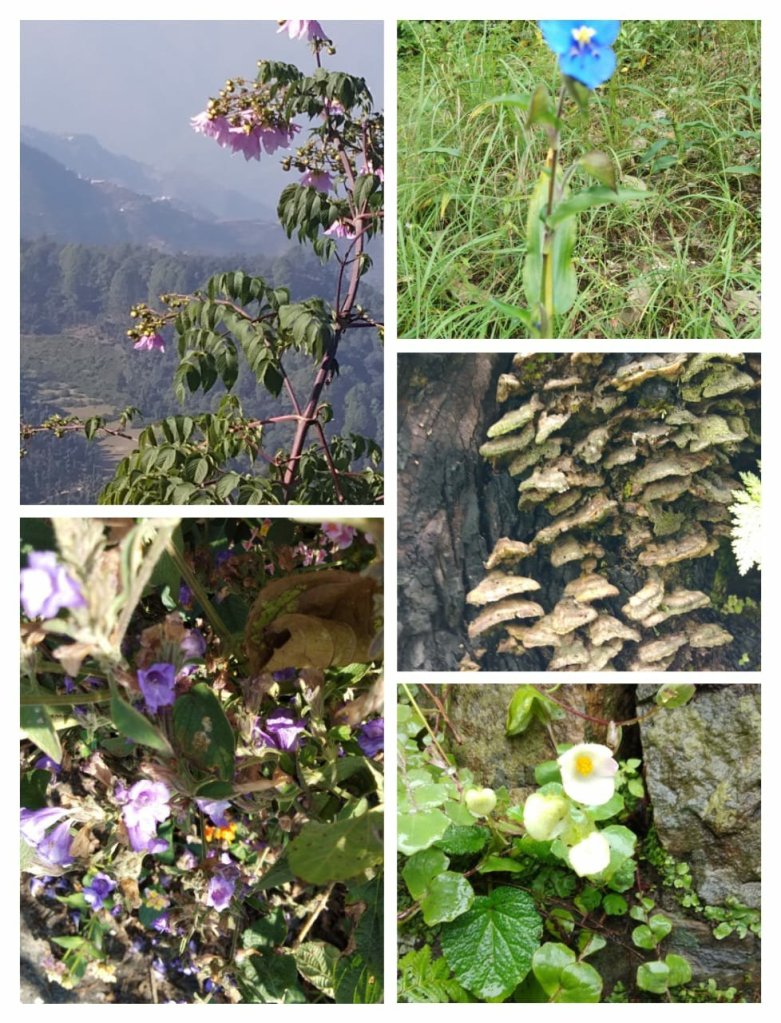
Diverse flora and mushrooms in Jabarkhet Nature Reserve

About 7 kilometres ahead of Woodstock school near Kaplani, there lies inclined bedding planes which are dipped in southwest angle. The bedding planes are made out of red sandstone. The beds display ferrous leaching. Joints and fracture also can be clearly seen. The sedimentary structure shows unique Ripple marks. The ripple marks are mostly present in the Sandstones, which are mostly ferruginous in content. The ripple marks at this site show different current directions.

Inclined bedding planes of Red Sandstone showing ripple marks near Kaplani
©sumanmitraphotography
Red Sandstone showing multiple fractures and joints
Mega ripple marks on Sandstone

In Dhobighat area, one can easily notice exposures of dolomitic limestone alongwith weathered cherty phosphorites. The beds dip in the northeast direction. Subsurfacial perennial affluent streams can be observed.

On a bright sunny day one can observe majestic view of the snow covered Himalayas, if one follows the road from Woodstock school towards Dhanaulty,

Picturesque Himalayas enroute Dhanaulty
©sumanmitraphotography
Panoramic view of the Himalayas enroute Batagad
©sumanmitraphotography

The scarp facets along the road has large detached rocks which have moved as rock-falls. Many roadside accident have also occurred in the past due to sudden rockfalls. In most places the fragmented boulders and rocks are loosely attached and can slide any moment. Due to increased transport near Mussoorie – Tehri road new road constructions are taking place.

Intercalation of bedding planes
Rock excavation

On a bright sunny day one can observe majestic view of the snow covered Himalayas, if one follows the road from Woodstock school towards Dhanaulty,

Mussoorie lies in the seismic zone 4 and has witnessed several earthquakes. These days one can observe numerous construction along roadsides as well as on slopes. According to recent reports an earthquake will collapse urban areas in Mussoorie and surrounding areas. So care should be taken while construction and damage assessment of the buildings should be done

Geology, soil and vegetation are not only interdependent but are also functionally
inseparable. The flora is an important factor of soil formation and the floral composition in an area also gives an insight into soil and geomorphic and geological conditions. Changes in either vegetation or soil cover are interalia affect each other.

Vegetation around Woodstock school, Mussoorie
©sumanmitraphotography

Geology of an area or mountainous tract is very important for any mountaineer or rock climber. Climbers through their experience know that different types of rock affect the route to the summit. Climbers also have the knowledge that some rock are durable whether others are fragile.

Mountaineer (Suman Mitra) exploring geological terrains
©sumanmitraphotography

There are ample research work available on the geological studies around Mussoorie, but during my study I didn’t came across any work which studies the geology in and around Woodstock school. Despite covering vast geographical area of around 300 acres, which mainly comprise of Oak, Deodar and Pine forest not enough attention is given towards the geology as well as changing geomorphology of this particular area. There are ample rock exposures where students can visit to study various geological aspects.The information presented in this blog is far from complete. However, effort is to collect information and continue studies and further update more information  and go on for the quest of knowledge of the geological setup of this particular area.

Geology is an essential knowledge: climbing success – or even your life – can depend on your understanding the form and substance that form the mountains…verse from the book.. Mountaineering… Freedom of the hills.

Thank you!!

@chandrimadebi

Picture courtesy

https://www.facebook.com/SumanMitraPhotography

https://www.sumanmitra.com/
copyright @sumanmitraphotography

©All images and content are subjected to copyright

Corona Virus COVID -19… Seems someone opened Pandora’s box!!!!

The novel corona virus COVID-19  is spreading its network in the global population and it’s difficult for anyone to escape it’s impact on the society. People from all sections of the society, be rich or poor are in the cruel grip of this novel virus.There is an expanding global outbreak of a respiratory illness caused by this virus. While most COVID-19 cases were initially associated with travel, person-to-person spread is on the rise. Millions of people across India are under lockdown until the end of the month as efforts to check the spread of the novel coronavirus in the country intensify. There is lockdown in 22 states of India and curfew in several states , still, there is a sense of negligence in some places and people are panicking  in different parts of the nation.

In the present age of innovated science and technology, we are prepared to deal nuclear war but we are handicapped to deal with pathogenic microorganisms and diseases. Looking at the present situation, it seems that we have long way to go. Seems someone opened Pandora’s box which resulted in disease and sorrow on Earth. With the permafrost melting and uncovering of the past disease symptoms are exposed for which we don’t have any cure. As we are all aware of the life threatening consequences of corona virus , the sanity lies in behaving in a rational and reasonable manner and not to panic and avoid bullrush. 

In ancient Vedic texts, there is mention of disease, epidemics, war and sorrow in the later stages of Kaliyuga. The ancient scholars through their astrological calculations already predicted the pandemic thousands of years ago. Based on the solar and lunar eclipse cycles these prediction may provide insight into the future calamities. The nature functions in the sole principal of isostacy ie. balance. As we are connected to nature, we must try to live a balanced life. Many philosophers and enlightened souls have already revealed that too much of anything is poison and we must utilitize the resources judiciously and responsively.
The clue for crippling the corona virus lies in the nature. We have to look beyond the possibilities to decode the cipher that lies in the nature. Scientists have suggested number of existing compounds for trials but WHO is focusing on the four most promising therapies: an experimental antiviral compound called remdesivir; the malaria medications chloroquine and hydroxychloroquine; a combination of two HIV drugs, lopinavir and ritonavir; and that same combination plus interferon-beta, an immune system messenger that can help defeat viruses.In the recent study, the scientists investigated 26 of the coronavirus’s 29 genes, which direct production of the viral proteins.

We all know that medicine and vaccines will take some time to reach the market, till then we can protect ourselves by achieving ‘Swasthaya’ ie. health. We can adopt certain healthy habits which will boost our immunity system to defend against various disease causing pathogens. Medicinal herbs such as amla, giloy, ginger, tulsi, turmeric, shilajit and neem are helpful in strengthening the immune system and are efficient in fighting this deadly virus. Due to the seasonal variation, cough and congestion are common these days but amidst corona outbreak we should not take symptoms lightly and immediately consult doctor.

But nature has its own way of healing. In the remote villages, the ethnic and rural people practice certain remedies which they believe are helpful in keeping the diseases away specially, chicken pox, diarrhoea, flu etc. They hang bundle of leaves of Neem tree, tulsi, lemongrass, turmeric etc along the entrance of their houses and believe that it will cast away the diseases from the entrance only. They also create smoke of these medicinal herbs and believe that it will eradicate pathogens in the environment. There is a herbal remedy which is very beneficial during this season.One teaspoon of juice of raw turmeric and neem leaves increases immunity and detoxifies also.  Turmeric and Neem leaves have many medicinal properties. Bathing with lukewarm water with neem leaves decoction is also very beneficial. In Hinduism there is a goddess named ‘Shitlaa’ mata who is worshipped to protect from such diseases. Besides, the ethnic and the rural people consume organic and fresh fruits and vegetables which provide them immunity.

There are various other ways like Yoga, naturopathy, pranic healing, salt therapy etc through which one can boost immunity and achieve health. People diagnosed with conora virus are quarantined and suspects are under isolation. Rest population should practice social distancing and self isolation so that the spread of the diseases can be checked. With the rapidly increasing cases of this deadly virus, we should not be stressed and take charge of our own psychosocial behaviours by practicing these remedies.

As there is no proper treatment available to cure the disease, preventive measures are the only possible way looking forward.The rate at which it is rapidly spreading has triggered a global health emergency. In this difficult time we should work hand-in-hand to spread awareness and assist others to prevent panic.

If there is heaven, there is hell too,
If there are highs there are lows too
If there is happiness, there are sorrows too
If there are mountains there are oceans too,
If there is disease there is cure too.

Corona Virus COVID -19… Seems someone opened Pandora’s box!!!!

The novel corona virus COVID-19  is spreading its network in the global population and it’s difficult for anyone to escape it’s impact on the society. People from all sections of the society, be rich or poor are in the cruel grip of this novel virus.There is an expanding global outbreak of a respiratory illness caused by this virus. While most COVID-19 cases were initially associated with travel, person-to-person spread is on the rise. Most of the states in India is under lockdown until the end of the month as efforts to check the spread of the novel corona virus in the country intensify. Despite of lockdown in 22 states of India and curfew in several states , there is a sense of negligence in some places. People are under panick  in different parts of the nation.

In the present age of innovated science and technology, we are prepared to deal nuclear war but we are handicapped to deal with pathogenic microorganisms and diseases. Looking at the present situation, it seems that we have long way to go. Seems someone opened Pandora’s box which resulted in disease and sorrow on Earth. With the permafrost melting and uncovering of the past disease symptoms are exposed for which we don’t have any cure. As we are all aware of the life threatening consequences of corona virus , the sanity lies in behaving in a rational and reasonable manner and not to panic and avoid bullrush. 

In ancient Vedic texts, there is mention of disease, epidemics, war and sorrow in the later stages of Kaliyuga. The ancient scholars through their astrological calculations already predicted the pandemic thousands of years ago. Based on the solar and lunar eclipse cycles these prediction may provide insight into the future calamities. The nature functions in the sole principal of isostacy ie. balance. As we are connected to nature, we must try to live a balanced life. Many philosophers and enlightened souls have already revealed that too much of anything is poison and we must utilitize the resources judiciously and responsively.

The clue for crippling the corona virus lies in the nature. We have to look beyond the possibilities to decode the cipher that lies in the nature. Scientists have suggested number of existing compounds for trials but WHO is focusing on the four most promising therapies: an experimental antiviral compound called remdesivir; the malaria medications chloroquine and hydroxychloroquine; a combination of two HIV drugs, lopinavir and ritonavir; and that same combination plus interferon-beta, an immune system messenger that can help defeat viruses.In the recent study, the scientists investigated 26 of the coronavirus’s 29 genes, which direct production of the viral proteins.

We all know that medicine and vaccines will take some time to reach the market, till then we can protect ourselves by achieving ‘Swasthaya’ ie. health. We can adopt certain healthy habits which will boost our immunity system to defend against various disease causing pathogens. Medicinal herbs such as amla, giloy, ginger, tulsi, turmeric, shilajit and neem are helpful in strengthening the immune system and are efficient in fighting this deadly virus. Due to the seasonal variation, cough and congestion are common these days but amidst corona outbreak we should not take symptoms lightly and immediately consult doctor.

Nature has its own way of healing. In the remote villages, the ethnic and rural people practice certain remedies which they believe are helpful in keeping the diseases away specially, chicken pox, diarrhoea, flu etc. They hang bundle of leaves of Neem tree, tulsi, lemongrass, turmeric etc along the entrance of their houses and believe that it will cast away the diseases from the entrance only. They also create smoke of these medicinal herbs and believe that it will eradicate pathogens in the environment. There is a herbal remedy which is very beneficial during this season.One teaspoon of juice of raw turmeric and neem leaves increases immunity and detoxifies also.  Turmeric and Neem leaves have many medicinal properties. Bathing with lukewarm water with neem leaves decoction is also very beneficial. In Hinduism there is a goddess named ‘Shitlaa’ mata who is worshipped to protect from such diseases. Besides, the ethnic and the rural people consume organic and fresh fruits and vegetables which provide them immunity.

There are various other ways like Yoga, naturopathy, pranic healing, salt therapy etc through which one can boost immunity and achieve health. People diagnosed with conora virus are quarantined and suspects are under isolation. Rest population should practice social distancing and self isolation so that the spread of the diseases can be checked. With the rapidly increasing cases of this deadly virus, we should not be stressed and take charge of our own psychosocial behaviours by practicing these remedies.

As there is no proper treatment available to cure the disease, preventive measures are the only possible way looking forward.The rate at which it is rapidly spreading has triggered a global health emergency. In this difficult time we should work hand-in-hand to spread awareness and assist others to prevent panic.

If there is heaven, there is hell too,
If there are highs there are lows too
If there is happiness, there are sorrows too
If there are mountains there are oceans too,
If there is disease there is cure too!!!!!

Clean Yamuna… ecological chimera!!!

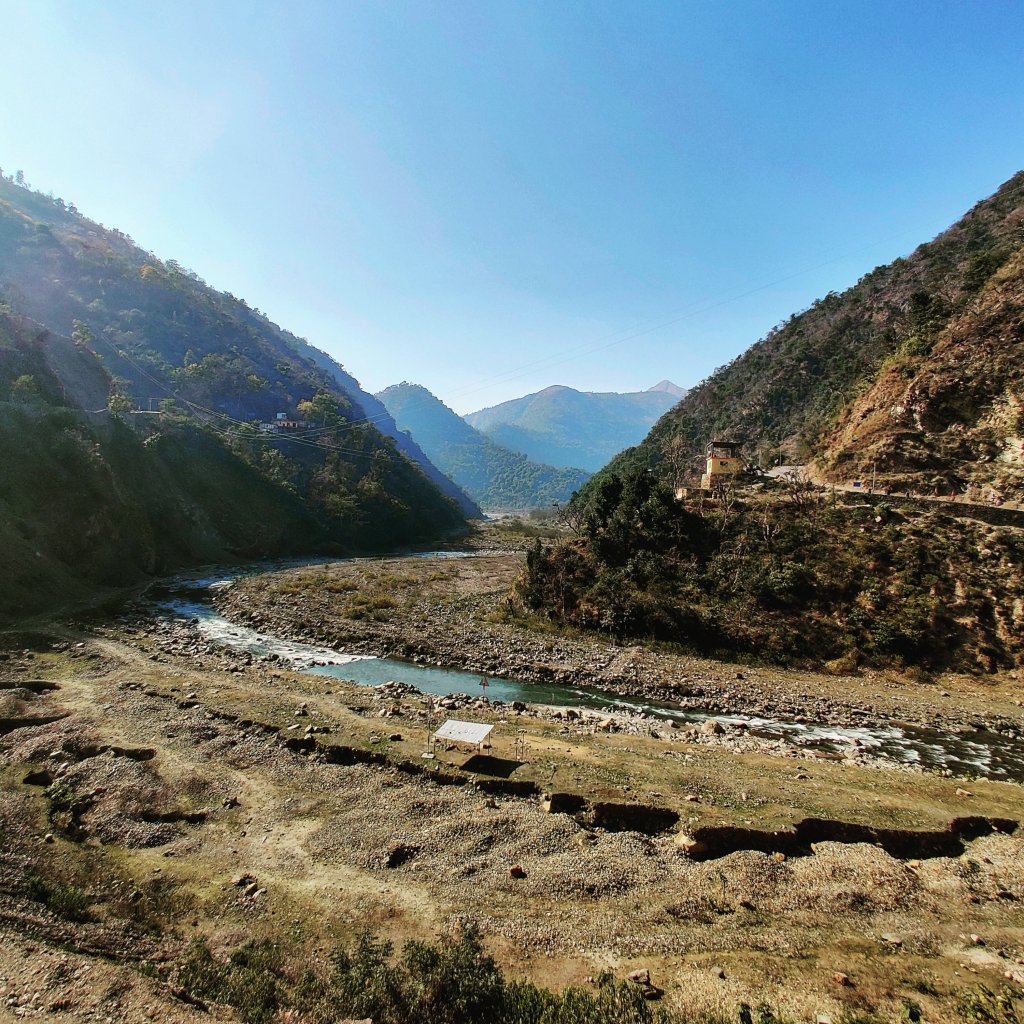
Yamuna….a river which is facing the wrath of the cruelty of mankind towards our rivers. The toxicity level of the polluted water of this religiously pious river is dangerous in and around Delhi. But, in the upper courses of Uttrakhand one can still experience clear water of river Yamuna. The river here flows through the mountainous terrains into the valley. The clear blue water gorges through the rocky terrain depicting as if almighty has laid a blue satin ribbon over a white linen. The landscape in the upper courses of Uttrakhand is still beautiful and serene. But with the rapid urbanisation, unsustained tourism, I wonder for how long mother nature will be able to hide this beauty and the biodiversity associated in her arms.

River Yamuna, Uttarakhand

Today I got the news that ahead of US president’s visit to Taj Mahal in Agra around 500 cusecs of water has been released from Upper Ganga Canal to meet water scarcity and improve the environmental condition of flowing along one of the seven wonders of the world. River Ganga according to Hindu mythology purifies the impure, I hope this effort might ease the purification process of River Yamuna even though Yamuna is the tributary of Ganga. Atleast for few days River Yamuna will be breathing. I am thankful to American President that amidst his visit to India, these clean up projects are actually realised and getting implemented. For few days we will witness that river Yamuna is flowing clean atleast around Taj Mahal.
Massive cleaning up projects are being taken up for the same and the government is also shelling ample funds. Afterall Mr. and Mrs. Trump are our guests and in India we believe in athiti devobhava. After the implementation of Swachch Bharat mission, this might be the first time one might experience the true vibes of Swachchata aka cleanliness that too along one strip in India ie Delhi -Agra- Ahmedabad.  Sometimes I feel India is getting limited only in this particular region. This cleaning process will again go back to the same pace because everytime this much quantity of water cant be released to Yamuna through canals, moreover we are used to the basic idea that Yamuna is polluted (status quo).

The global warming has already affected the melting of the massive glaciers in Yamunotri. The clear water flows through Uttarakhand down to the Indo-Gangetic plain where it gets polluted. The rate of pollution entering in Yamuna is higher than the cleaner water being added up in the mainstream. Why the Yamuna river can’t be cleaned permanently ? I wonder for how long we will live with this virtual happiness and put our future at stake.

Today it’s a river and tomorrow entire mankind….!!!!!